
What Autism Really Is
Let’s start with the question almost every parent asks.
What is Autism?
Autism, or Autism Spectrum Disorder (ASD), is a neurodevelopmental condition.
That’s a medical way of saying that a child’s brain develops and processes information differently.
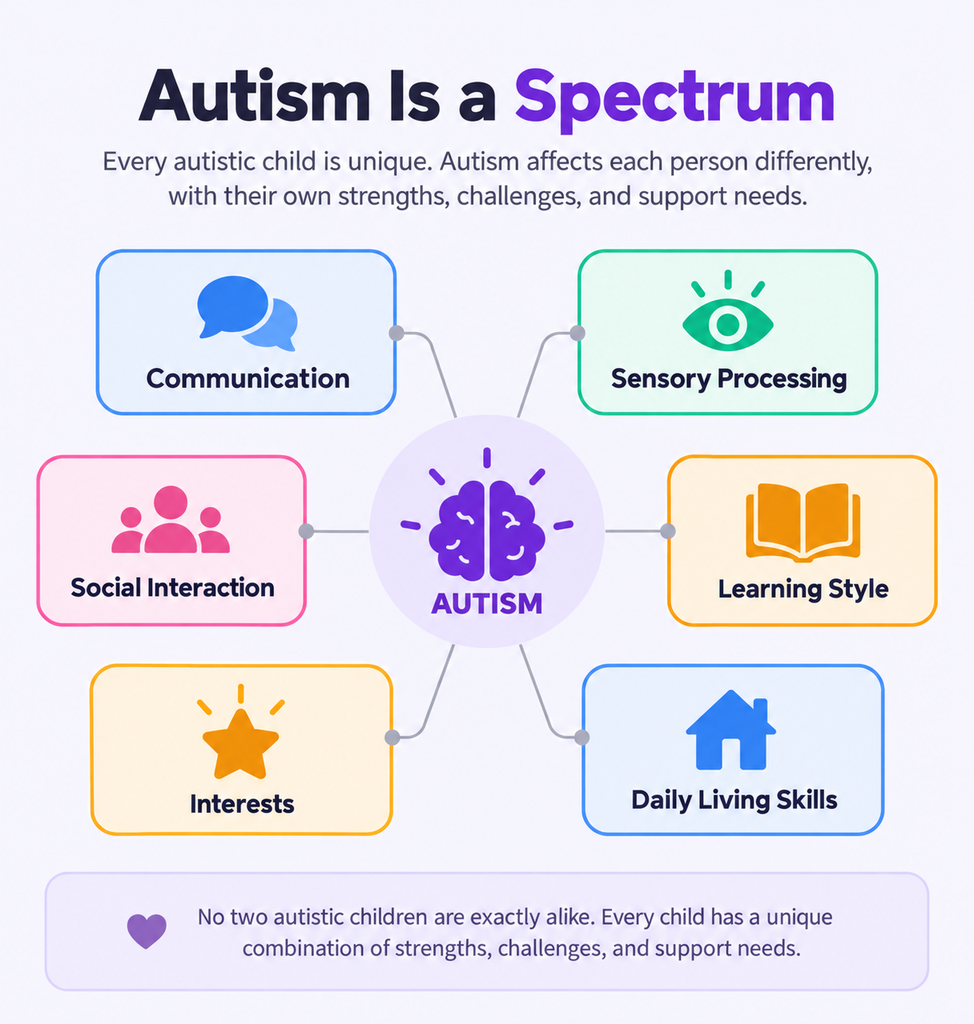
Those differences can affect areas such as:
- Communication
- Social interaction
- Learning
- Behaviour
- Sensory processing
- Daily routines
- Emotional regulation
Some children have mild challenges.
Others need significant daily support.
Some speak fluently.
Some communicate using pictures or assistive devices.
Some love social interaction.
Others find it exhausting.
Every autistic child is unique.
That’s why it’s called a spectrum.
Autism is not an illness to be “caught” or “cured.” It is a lifelong neurodevelopmental condition that affects how a person experiences and interacts with the world.
Understanding the Word “Spectrum”
When many people hear the word spectrum, they imagine a straight line.
They think…
“Mild autism on one end.”
“Severe autism on the other.”
In reality, autism doesn’t work like that.
Think of it more like a sound mixing board.
One child may have:
- strong language
- significant sensory challenges
- excellent memory
- difficulty making friends
Another child may have:
- limited speech
- fewer sensory issues
- strong visual learning
- difficulty with daily routines
Both are autistic.
Both have different strengths.
Both have different challenges.
Neither child’s experience is more “real” than the other.
Autism Is Different—Not Less
One of the most important things I’ve learned is this.
Our children are not broken.
They don’t need to become someone else.
They need understanding.
Support.
Opportunities.
And people who see their strengths as well as their challenges.
Autism changes how a child experiences the world.
It doesn’t define their worth.
The day we stopped asking, “Why is my son doing this?” and started asking, “What is he trying to tell us?” our parenting changed.
What Research Tells Us
Researchers around the world have spent decades studying autism.
Organizations such as the World Health Organization (WHO), the Centers for Disease Control and Prevention (CDC), the National Institutes of Health (NIH), the American Academy of Pediatrics (AAP), and India’s NIEPID all describe autism as a neurodevelopmental condition that affects communication, behaviour, and social interaction in different ways.
They also emphasize something important:
Early identification and appropriate support can help children develop communication, daily living, and social skills.
That doesn’t mean every child will develop in the same way.
But it does mean that early support matters.
We’ll talk much more about that later in this guide.
What Autism Is NOT
Sometimes understanding what autism isn’t is just as important.
Let’s clear up some common misconceptions.
Autism is NOT caused by bad parenting.
Parents do not cause autism.
Loving your child differently would not have prevented autism.
Being stricter would not have prevented autism.
This is one of the biggest myths parents still hear.
It simply isn’t supported by scientific evidence.
“Autism is NOT an illness you catch.
Autism is not contagious.
It cannot spread from one child to another.”
Autism is NOT something children “grow out of.”
Autism is lifelong.
However…
Children absolutely can learn.
They can develop.
They can become more independent.
Many children make tremendous progress with appropriate support.
Autism is NOT the same for every child.
This is probably the biggest misunderstanding.
Two autistic children can look completely different.
One child may speak in full sentences.
Another may communicate using pictures.
One may enjoy school.
Another may struggle with classrooms.
Both are autistic.
Autism is NOT defined only by challenges.
This is something I want LeapAgo to remember in every article.
Our children also have strengths.
Some have incredible memories.
Some notice details others miss.
Some are deeply honest.
Some are wonderfully creative.
Some develop remarkable interests and talents.
Our job isn’t just to help them overcome challenges.
It’s also to help those strengths grow.
What This Looked Like in Our Home
When I look back at our own journey with Suhas, I realise that we didn’t recognise autism overnight.
It wasn’t one dramatic moment.
It was many small observations.
There were things that seemed unusual.
There were things we explained away.
There were things relatives told us not to worry about.
Like many parents, we wondered if he was simply developing at his own pace.
Over time, though, we realised we needed answers instead of assumptions.
Looking back now, I don’t wish we had worried more.
I wish we had understood more.
That’s one of the biggest reasons I’m writing this guide.
If our experiences can help another family recognise patterns earlier, ask better questions, or simply feel less alone, then sharing our journey is worthwhile.
I also want to be honest about something.
We’re still on this journey.
There isn’t a chapter where everything suddenly becomes perfect.
We’re still learning.
We’re still adapting.
We’re still celebrating small victories.
And that’s okay.
Why This Guide Exists
The internet has millions of pages about autism.
Some are excellent.
Some are outdated.
Some are frightening.
Some promise unrealistic results.
My goal isn’t to replace your doctor.
It’s not to replace your therapist.
Instead, I want this guide to become something you return to whenever you have a question.
A place that combines:
- Current evidence from trusted organizations.
- Practical ideas that parents can actually use.
- Honest stories from our own journey.
- Hope without making unrealistic promises.
As LeapAgo grows, every article on this website will connect back to this guide.
Think of this page as the foundation.
We’ll explore speech, sensory processing, behaviour, therapies, school, daily routines, and family life in much greater detail throughout this series.
What You’ll Learn in the Rest of This Guide
Over the next sections, we’ll cover:
- How to recognise early signs of autism.
- How autism is diagnosed.
- Understanding the autism spectrum.
- Speech and communication.
- Sensory processing.
- Behaviour and emotional regulation.
- Therapies available for children.
- School and education.
- Daily life at home.
- Looking after yourself as a parent.
- Trusted resources in India and around the world.
My hope is that by the time you finish this guide, you’ll feel less overwhelmed and more prepared for the journey ahead.
💙 A Note From One Parent to Another
If you’ve read this far, thank you for trusting me with your time.
I know this journey can feel uncertain.
I know there are days when you wonder if you’re doing enough.
I still have those days too.
But here’s something I’ve learned.
Our children don’t need perfect parents.
They need parents who keep showing up.
Who keep learning.
Who keep loving them exactly as they are while helping them grow into who they can become.
That’s what I’m trying to do with Suhas.
And if you’re reading this, I have a feeling that’s exactly what you’re trying to do for your child too.
So let’s continue this journey together.
Welcome to LeapAgo.
—
Sridhar K
Founder, LeapAgo
📖 What’s Included in This Guide
This guide is designed to be read in order. Each part builds on the previous one to help you understand autism and support your child with greater clarity.
📍YOU ARE HERE
Part 1 – What Is Autism?
Current Article
○ Part 2 – Early Signs of Autism
○ Part 3 – Communication and Speech
○ Part 4 – Sensory Processing and Behaviour
○ Part 5 – Understanding Therapies
○ Part 6 – Daily Life with Autism
○ Part 7 – Looking After Yourself as a Parent
○ Part 8 – Frequently Asked Questions
○ Part 9 – Autism Resources in India