

Communication Is Much More Than Talking
If you’re like most parents, one of the biggest dreams you probably have is hearing your child call you “Mom” or “Dad.”
I understand that feeling.
When a child isn’t talking yet, it can feel heartbreaking.
You begin comparing your child with others.
You start counting every new word.
You celebrate sounds that other parents might never even notice.
But over time, I learned something that completely changed how I looked at communication.
Communication is much bigger than speech.
Before children ever say their first words, they’re already communicating.
A baby cries because they’re hungry.
A toddler reaches for a toy because they want it.
A child pulls your hand toward the refrigerator because they’re asking for food.
Those are all forms of communication.
Speech is one way to communicate—but it isn’t the only way.
This was one of the biggest mindset shifts for me as a parent.
Instead of asking,
“Why isn’t my child talking?”
I slowly began asking,
“How is my child trying to communicate with me today?”
That question opened my eyes.
Understanding Communication in Autism
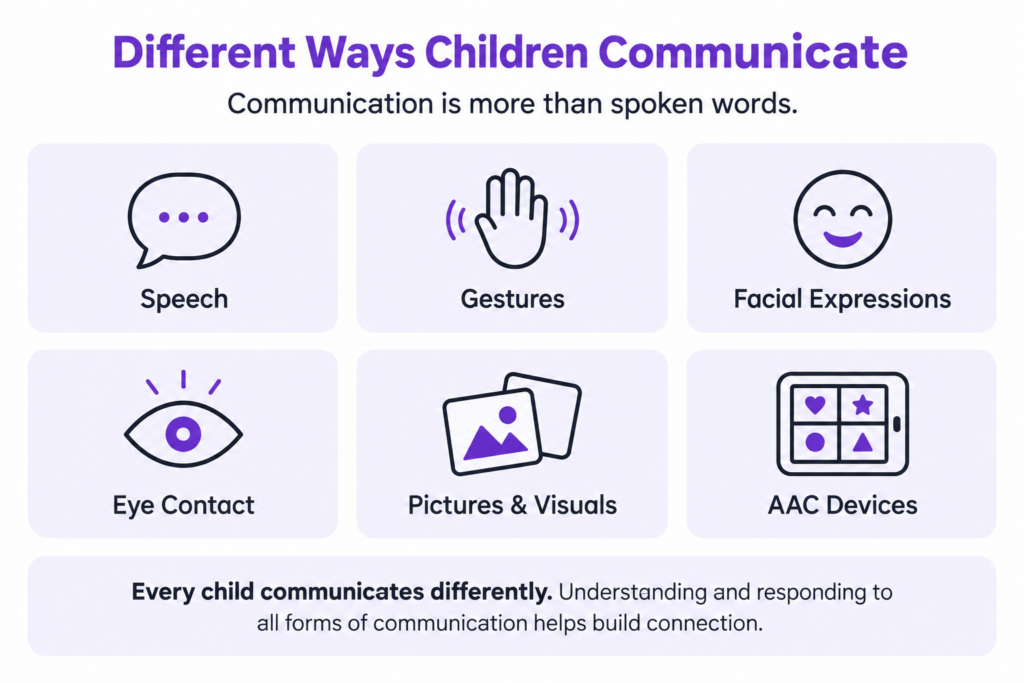
Children on the autism spectrum communicate in many different ways.
Some speak in full sentences.
Some use only a few words.
Some communicate using pictures.
Some type on tablets.
Some point.
Some use gestures.
Some lead their parents to what they need.
Some communicate mostly through behaviour.
Every one of those methods deserves respect.
The goal isn’t simply getting children to speak.
The goal is helping them communicate their thoughts, needs, emotions, and choices in the best way they can.
Organizations such as the American Speech-Language-Hearing Association (ASHA) and the National Institute on Deafness and Other Communication Disorders (NIDCD) emphasize that communication includes spoken language, gestures, facial expressions, body language, and alternative communication methods. Helping a child communicate effectively—regardless of the method—can reduce frustration and increase participation in daily life.
Speech Delay in Autism
One of the first questions parents usually ask is:
“My child isn’t talking yet. Does that automatically mean autism?”
The answer is no.
Speech delay and autism are related, but they are not the same thing.
Some children have a speech delay without autism.
Some autistic children begin speaking later.
Some speak on time but struggle with conversations.
Some become highly verbal.
Others continue to use alternative forms of communication throughout life.
Every child follows a different developmental path.
What Is Speech Delay?
Speech delay simply means a child’s spoken language is developing more slowly than expected for their age.
A child with speech delay may:
- Understand much more than they can say.
- Try to communicate through gestures.
- Enjoy interacting with others.
- Respond well to their name.
- Point to things they want.
These children may simply need additional speech and language support.
Speech Delay in Autism
When speech delay is part of autism, parents often notice additional differences, such as:
- Reduced response to their name.
- Limited eye contact.
- Less pointing or showing objects to others.
- Difficulty with back-and-forth interaction.
- Repetitive use of words or phrases.
- Strong sensory interests or repetitive behaviours.
It’s the combination of communication, social interaction, and behavioural patterns that helps professionals determine whether autism might be present.
What This Looked Like in Our Home
One of the hardest parts of our journey with Suhas was waiting for words.
Every new sound filled us with excitement.
Every silence filled us with questions.
Like many parents, we wondered if we were doing enough.
Should we read more books?
Should we spend more time talking?
Should we change therapies?
Looking back, I realise there wasn’t one magical activity that suddenly changed everything.
Progress came through many small moments—daily interaction, consistent routines, therapy sessions, and celebrating every attempt to communicate, whether it was a sound, a gesture, or a look.
That experience taught me not to measure success only by the number of words spoken.
Communication grows in many different ways.
Practical Ways Parents Can Encourage Communication
While every child is different, many therapists encourage parents to create communication opportunities throughout the day rather than limiting practice to “therapy time.”
Some simple ideas include:
- Pause before giving your child a favourite toy, giving them an opportunity to communicate in their own way.
- Offer two choices (“Apple or banana?”) instead of asking open-ended questions.
- Narrate everyday activities using simple language.
- Read picture books together and point to objects.
- Sing familiar songs with pauses, allowing your child to fill in a sound or word if they’re ready.
- Celebrate every attempt to communicate, even if it’s not perfect.
These small interactions, repeated consistently, often become more meaningful than one long practice session.
Understanding Echolalia
One of the words that frightened me early in our journey was echolalia.
It sounded like something serious.
In reality, it’s much easier to understand than the name suggests.
Echolalia simply means repeating words, phrases, or sentences that a child has heard before.
For example, a child might:
- Repeat a line from a favourite cartoon.
- Repeat your question instead of answering it.
- Say the same phrase many times during the day.
Many parents worry that this means their child isn’t learning language.
But research suggests echolalia can actually be part of language development for some autistic children.
Sometimes children repeat language because they’re processing it, practising it, or using it to communicate before they can generate original sentences consistently.
Immediate and Delayed Echolalia
Professionals often describe two common patterns.
Immediate echolalia
The child repeats something immediately after hearing it.
Parent:
“Do you want juice?”
Child:
“Do you want juice?”
Delayed echolalia
The child repeats something they heard earlier, sometimes hours, days, or even weeks later.
For example, a child might suddenly quote a line from a television programme because that phrase expresses how they’re feeling.
Instead of seeing echolalia as “meaningless repetition,” many speech-language professionals encourage parents to look for the purpose behind it.
What Is AAC?
One of the biggest misconceptions I hear is:
“If my child starts using AAC, they’ll never learn to speak.”
Current research does not support that fear.
AAC stands for Augmentative and Alternative Communication.
It’s a broad term for tools that help people communicate.
AAC may include:
- Picture cards.
- Communication boards.
- Visual symbols.
- Sign language.
- Tablet-based communication apps.
- Speech-generating devices.
These tools don’t replace communication.
They support it.
Many children use AAC while continuing to develop spoken language.
For others, AAC becomes their primary way of expressing themselves.
Either outcome is valuable because every child deserves a reliable way to communicate.
Why AAC Matters
Imagine knowing exactly what you want but having no reliable way to tell anyone.
That frustration can lead to tears, meltdowns, or behaviours that are often misunderstood.
Giving a child a way to communicate can reduce frustration and increase independence.
The goal isn’t choosing between speech and AAC.
The goal is communication.
Eye Contact
Eye contact is one of the topics that creates the most confusion for parents.
Many people assume that if a child doesn’t make eye contact, they’re ignoring others.
In reality, eye contact can be uncomfortable or overwhelming for some autistic children.
Rather than forcing eye contact, many professionals recommend encouraging shared interaction.
A child doesn’t always have to look directly into your eyes to connect with you.
They may look at your face briefly.
They may glance while playing.
They may show connection in other ways.
The quality of the interaction is often more important than the length of eye contact.
Gentle Ways to Encourage Connection
Instead of saying,
“Look at me!”
Try:
- Holding a favourite toy near your face.
- Playing face-to-face games.
- Singing action songs together.
- Waiting for natural moments when your child looks toward you.
- Smiling and responding warmly whenever they initiate interaction.
The goal is connection—not compliance.
Joint Attention
Joint attention is a phrase many parents hear during therapy sessions.
It simply means sharing attention with another person toward the same object or activity.
For example:
Your child points to an airplane.
You both look at it together.
You’re sharing attention.
Another example:
You’re reading a picture book together.
Your child looks at the picture.
Then looks at you.
Then back at the picture.
That’s joint attention.
This skill becomes an important foundation for language, learning, and social interaction.
Why Joint Attention Matters
Children learn a tremendous amount by sharing experiences with other people.
When they look where you point…
When they show you something exciting…
When they smile because you’re both watching the same bubbles…
They’re building communication long before full conversations begin.
Easy Joint Attention Activities at Home
You don’t need expensive materials.
Simple activities work beautifully.
Try:
- Blowing bubbles.
- Rolling a ball back and forth.
- Reading picture books.
- Playing with toy cars together.
- Building towers.
- Looking out the window together.
- Pointing to birds, dogs, or buses during walks.
The goal isn’t teaching perfectly.
The goal is sharing moments.
What Research Tells Us
Research from organizations such as the American Academy of Pediatrics (AAP), ASHA, NIDCD, and the CDC consistently shows that early support for communication can improve a child’s ability to participate in everyday life.
That support doesn’t look exactly the same for every child.
Some benefit most from speech-language therapy.
Others benefit from AAC.
Others need parent coaching alongside therapy.
There is no one-size-fits-all approach.
The most effective support is individualized, built around the child’s strengths, needs, and goals.
Key Takeaways
If there’s one message I hope you remember from this section, it’s this:
Communication is not measured only by words.
It’s measured by connection.
Every gesture…
Every point…
Every picture exchanged…
Every shared smile…
Every sound…
Every attempt to communicate matters.
Celebrate those moments.
They are the building blocks of language.
💙 A Note From One Parent to Another
If your child isn’t talking yet, I know how heavy that can feel.
I’ve sat in that uncertainty too.
Please don’t measure your child’s future by today’s vocabulary.
Children develop at different rates.
Some make steady progress over time.
Some communicate in ways we never expected.
Our responsibility isn’t to compare our children with anyone else.
It’s to keep giving them opportunities to connect with us.
Every meaningful interaction is a step forward.
And sometimes those small steps become the biggest victories.
—
Sridhar K
Founder, LeapAgo
📖 What’s Included in This Guide
This guide is designed to be read in order. Each part builds on the previous one to help you understand autism and support your child with greater clarity.
○ Part 1 – What Is Autism?
○ Part 2 – Early Signs of Autism
📍YOU ARE HERE
Part 3 – Communication and Speech
Current Article
○ Part 4 – Sensory Processing and Behaviour
○ Part 5 – Understanding Therapies
○ Part 6 – Daily Life with Autism
○ Part 7 – Looking After Yourself as a Parent
○ Part 8 – Frequently Asked Questions
○ Part 9 – Autism Resources in India