


Every Behaviour Has a Reason
If there’s one lesson autism has taught me as a father, it’s this:
Behavior is communication.
That sentence completely changed how I looked at parenting Suhas.
In the early days, I reacted the way many parents naturally do.
If Suhas threw something, I thought,
“Why is he doing this?”
If he screamed, I thought,
“How do I stop this?”
If he jumped on the sofa for the hundredth time, I wondered,
“Why won’t he listen?”
Over time, with guidance from therapists, reading trusted research, and simply observing my own son more carefully, I realized something that seems obvious now.
Most autistic behaviors aren’t random.
They’re meaningful.
Sometimes they communicate fear.
Sometimes they communicate excitement.
Sometimes they communicate pain.
Sometimes they communicate sensory overload.
Sometimes they communicate,
“I don’t know how to tell you what I need.”
That realization changed everything.
Instead of asking,
“How do I stop this behavior?”
I began asking,
“What is this behavior trying to tell me?”
That question made me a better parent.
My hope is that it helps you too.
Understanding Sensory Processing
Before we talk about behavior, we need to understand something called sensory processing.
It sounds like a complicated medical term, but it’s actually something we all do every second of every day.
Right now, as you’re reading this, your brain is processing:
- the light around you
- sounds in your room
- the feeling of your clothes
- the temperature
- where your body is sitting
- smells around you
Your brain automatically filters most of that information.
For many autistic children, that filtering process works differently.
Some sensations feel much stronger.
Some barely register at all.
That’s why two children can react completely differently to the same situation.
What Is Sensory Processing?
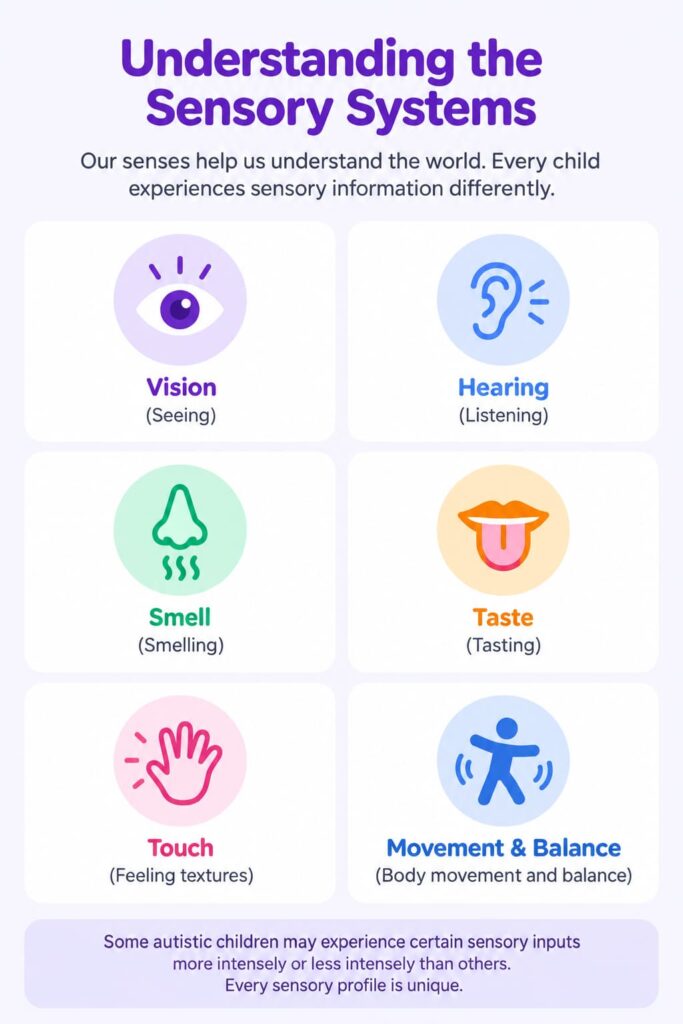
Sensory processing is simply the way the brain receives, organizes, and responds to information from our senses.
These include:
- Sight
- Hearing
- Touch
- Taste
- Smell
- Balance (vestibular system)
- Body awareness (proprioception)
- Internal body sensations (interoception)
According to organizations such as the CDC, AAP, and NIEPID, many autistic children experience differences in sensory processing. Some are highly sensitive to certain sensations, while others actively seek more sensory input.
Neither response is “wrong.”
It’s simply how that child’s nervous system experiences the world.
Sensory Seeking vs. Sensory Avoiding
One of the biggest breakthroughs for us as parents was learning that not all sensory behaviors are the same.
Sensory Seeking
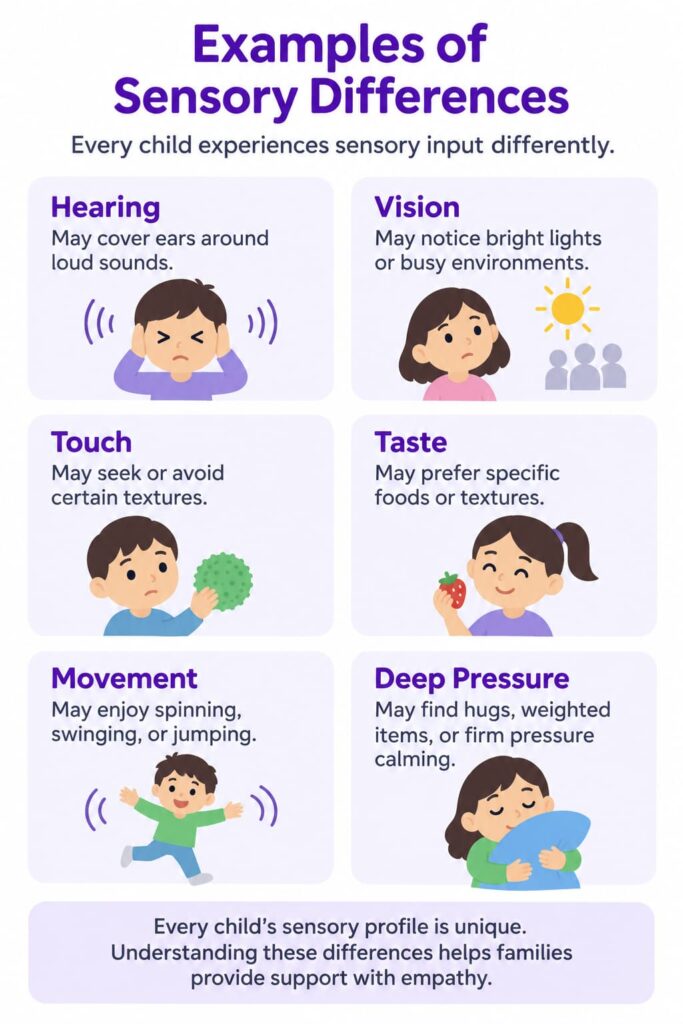
These children are looking for more sensory input.
You might notice them:
- Jumping constantly
- Crashing into cushions
- Spinning
- Chewing clothes
- Running everywhere
- Climbing furniture
- Looking closely at lights
- Touching everything
They’re not trying to misbehave.
Their bodies are looking for sensory input.
Sensory Avoiding
Other children experience the opposite.
They may:
- Cover their ears
- Avoid loud places
- Refuse certain clothes
- Hate haircuts
- Cry during nail cutting
- Refuse some food textures
- Become overwhelmed in shopping malls
- Avoid crowded places
Their nervous system experiences ordinary sensations as overwhelming.
What This Looked Like in Our Home
One of the biggest turning points for us came when we stopped seeing Suhas’s behaviors as “bad habits.”
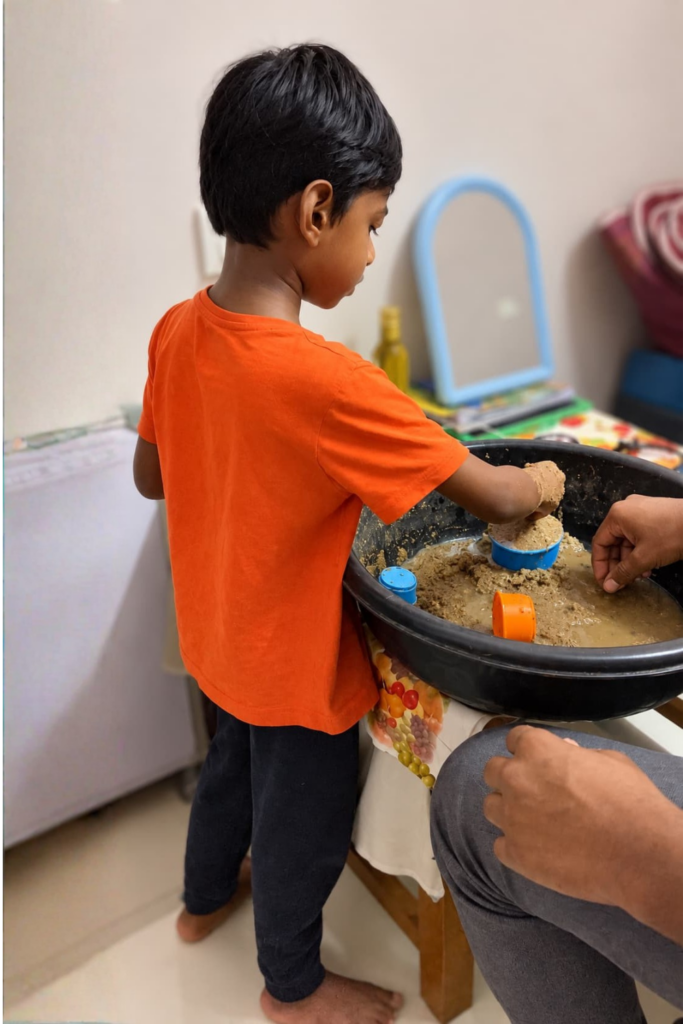
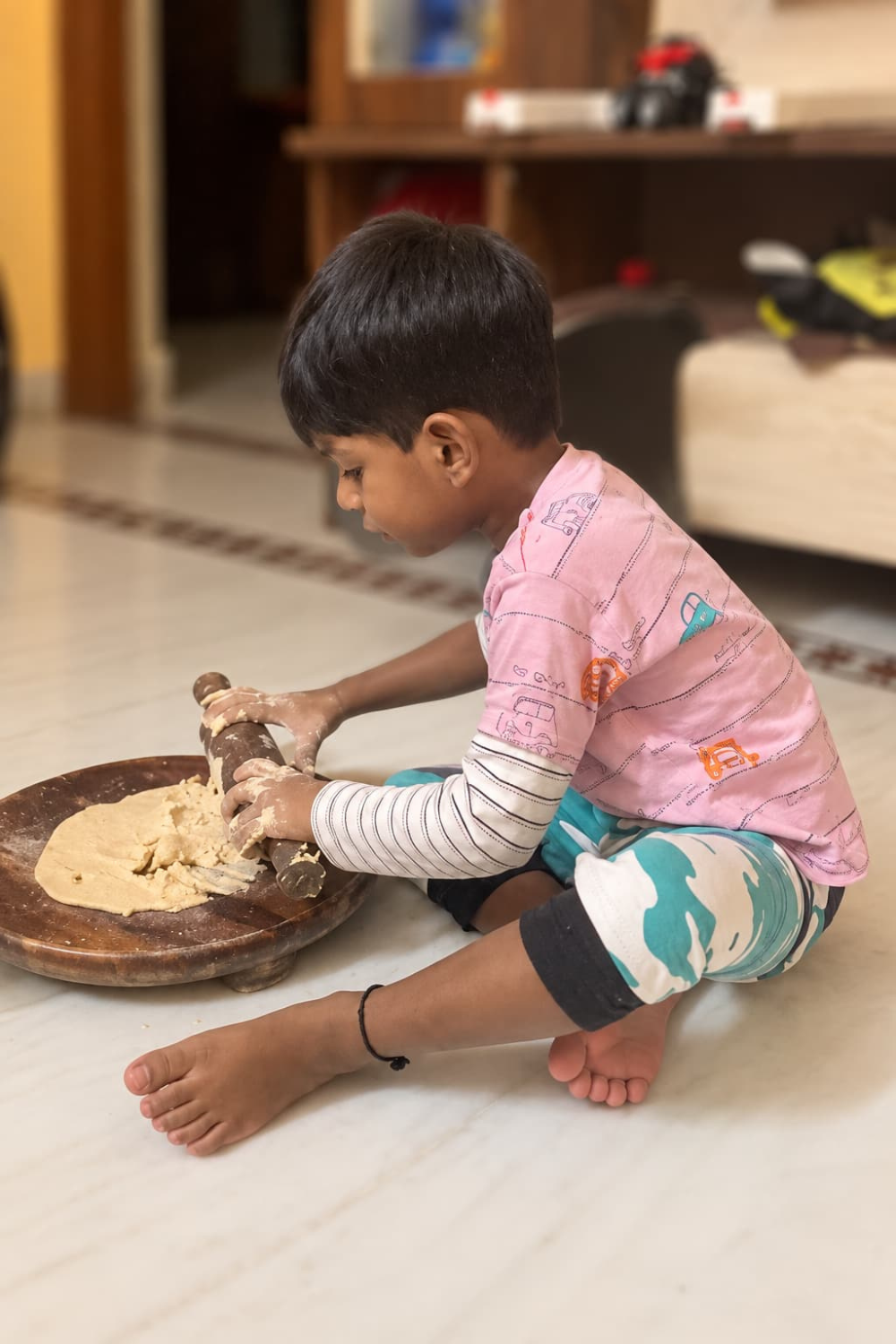
For example, there were days when he jumped from one cushion to another over and over again.
Our first instinct was to stop him.
After learning more about sensory processing, we realized he wasn’t simply “being naughty.”
His body was looking for movement.
Instead of constantly saying “Don’t jump,” we started creating safe opportunities for movement.
It didn’t eliminate the behavior overnight, but it changed how we responded.
Instead of conflict, there was understanding.
That one change made our home feel calmer.
Every child is different, and what helped Suhas may not be the right solution for every family, but learning to ask why before reacting made a huge difference for us.
What Is Stimming?
One word parents often hear after an autism diagnosis is stimming.
Stimming is short for self-stimulatory behavior.
It’s simply a way many autistic people regulate their bodies or emotions.
Examples include:
- Hand flapping
- Rocking
- Finger movements
- Humming
- Repeating sounds
- Spinning
- Watching objects spin
- Pacing
- Tapping fingers
- Repeating words
Many parents become worried when they first notice these behaviors.
I understand that feeling.
But here’s something important.
Not all stimming is harmful.
Why Do Children Stim?
Stimming can happen for many reasons.
Some children stim because they’re excited.
Some because they’re anxious.
Some because they’re overwhelmed.
Some because the movement simply helps their nervous system feel organized.
Think about what many adults do.
We tap our feet.
We twirl a pen.
We bite our nails.
We pace while talking on the phone.
Those are forms of self-regulation too.
Autistic children may simply regulate themselves differently.
Should Parents Stop Stimming?
This is one of the questions I hear most often.
The answer isn’t always yes or no.
If a stim is:
- Safe
- Not causing injury
- Not interfering significantly with learning or daily life
…it often doesn’t need to be stopped.
Instead, try to understand its purpose.
However, if a behavior causes injury or prevents the child from participating in important activities, it’s worth discussing strategies with your therapy team to provide safer alternatives.
The goal isn’t to make a child look “normal.”
The goal is to help them stay safe and participate in daily life.
Understanding Meltdowns
Meltdowns are probably one of the most misunderstood parts of autism.
Many people confuse meltdowns with tantrums.
They’re not the same.
A tantrum is generally a goal-directed behavior.
A meltdown is an overwhelming response to stress, sensory overload, anxiety, or emotional exhaustion.
During a meltdown, a child often isn’t trying to control anyone.
Instead, they’ve lost the ability to cope with what’s happening around them.
What Can Trigger a Meltdown?
Every child is different, but common triggers include:
- Loud noises
- Bright lights
- Crowded places
- Sudden changes in routine
- Communication frustration
- Hunger
- Fatigue
- Pain or illness
- Too many demands at once
Sometimes several small stressors build up throughout the day before the meltdown happens.
The trigger you see may not be the real cause.
What Parents Can Do During a Meltdown
One of the hardest lessons I learned was that reasoning usually doesn’t work in the middle of a meltdown.
When a child is overwhelmed, their nervous system is focused on survival, not problem-solving.
What often helps more is:
- Staying as calm as possible.
- Reducing noise and stimulation.
- Moving to a quieter place if it’s safe.
- Speaking slowly and simply.
- Giving the child time to recover.
- Keeping them safe without using unnecessary force.
Once the child is calm, that’s the time to reflect—not during the meltdown itself.
Understanding Aggression
Aggression is one of the topics parents often hesitate to talk about because it can feel embarrassing or frightening.
It’s important to remember that aggression is a behavior, not an identity.
Children may hit, bite, push, throw objects, or kick for many different reasons, including:
- Difficulty communicating
- Sensory overload
- Pain
- Anxiety
- Frustration
- Sudden changes in routine
The first question should always be:
“What happened before this behavior?”
Keeping a simple behavior diary can help identify patterns.
You may notice aggression happens:
- Before meals
- After school
- In noisy places
- During transitions
- When communication becomes difficult
Those patterns can guide more effective support.
Self-Regulation: The Skill We Build Over Time
One of the biggest goals for every child isn’t “perfect behavior.”
It’s learning self-regulation.
Self-regulation means gradually learning to:
- Recognize emotions
- Calm the body
- Manage frustration
- Recover from disappointment
- Transition between activities
These skills don’t appear overnight.
They develop over years.
Many autistic children need extra support to build them.
Practical Ways to Support Self-Regulation
Some strategies that many families find helpful include:
- Predictable daily routines
- Visual schedules
- Movement breaks
- Quiet sensory spaces
- Deep breathing (when appropriate)
- Heavy work activities such as pushing, pulling, or carrying
- Calm-down kits with preferred sensory items
- Preparing children before transitions
Not every strategy works for every child.
That’s okay.
Finding the right combination takes time.
What Research Tells Us
Research from organizations including the American Academy of Pediatrics, the CDC, and the National Autistic Society suggests that understanding the reasons behind behaviors—and adjusting the environment, communication, and supports accordingly—can be more effective than focusing only on stopping the behavior.
Rather than asking, “How do I make this behavior disappear?”, professionals often encourage families to ask:
- What is my child communicating?
- What happened before the behavior?
- What happened after it?
- Is there a sensory need?
- Is my child overwhelmed, tired, hungry, or in pain?
These questions lead to better long-term solutions.
Key Takeaways
If you remember only one thing from this section, let it be this:
Behavior is information.
Every behavior is an opportunity to understand your child better.
Some behaviors tell us:
- “I’m overwhelmed.”
- “I need movement.”
- “I’m scared.”
- “I don’t understand.”
- “I can’t tell you what I need.”
When we respond with curiosity instead of immediate judgment, we create more opportunities for connection and learning.
💙 A Note From One Parent to Another
There were days when I felt completely exhausted.
Days when I wondered if I was doing something wrong because I couldn’t stop certain behaviors.
Looking back, I realize that the biggest change didn’t happen when Suhas changed.
It happened when I changed the way I understood him.
I stopped seeing behaviors as problems to fix.
I started seeing them as messages to understand.
I’m still learning.
I’m still making mistakes.
But every time I choose understanding before frustration, I become the kind of parent I hope my son remembers.
If you’re reading this after a difficult day, please know this:
Tomorrow is another opportunity to learn your child’s language.
And every small step you take to understand them is a step toward a stronger relationship.
—
Sridhar K
Founder, LeapAgo
📖 What’s Included in This Guide
This guide is designed to be read in order. Each part builds on the previous one to help you understand autism and support your child with greater clarity.
○ Part 1 – What Is Autism?
○ Part 2 – Early Signs of Autism
○ Part 3 – Communication and Speech
📍YOU ARE HERE
Part 4 – Sensory Processing and Behaviour
Current Article
○ Part 5 – Understanding Therapies
○ Part 6 – Daily Life with Autism
○ Part 7 – Looking After Yourself as a Parent
○ Part 8 – Frequently Asked Questions
○ Part 9 – Autism Resources in India