

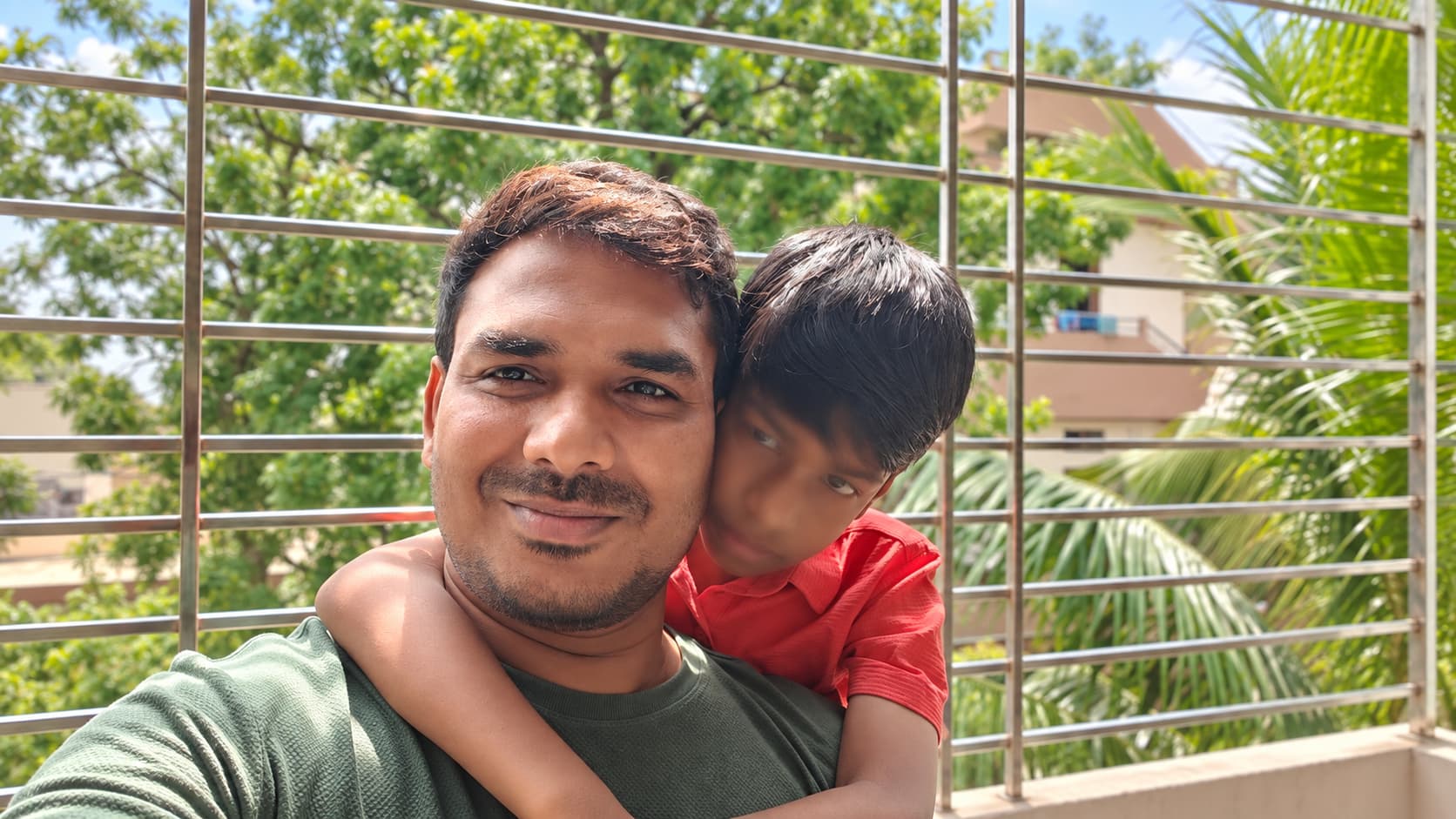
A Practical Guide for Parents Looking for the Right Doors to Knock On
Last fact-checked: September 2026
When we begin our autism journey as parents, a surprising amount of our energy goes into simply figuring out where to go.
Which hospital can issue a certificate?
Is a diagnosis the same as a disability certificate?
What exactly is a UDID card?
Does my child have a right to attend school?
Are there government schemes for autism?
Who checks whether a special educator or rehabilitation professional is properly qualified?
What happens when our children become adults?
And perhaps the most confusing question of all:
Which websites and organizations can I actually trust?
I have felt that confusion myself.
When we are already trying to manage therapies, school, behaviour, communication, work, finances and family life, government terminology can feel like another language altogether.
So for the final part of our Autism Complete Guide Series, I wanted to create the resource guide I would want another parent to hand me.
Not a directory containing hundreds of links.
Not legal jargon.
Just the important systems parents in India should know about, explained one step at a time.
I am a parent sharing personal experiences and educational information, not a doctor, therapist or lawyer. This article is not intended to diagnose any child, provide legal advice, or replace advice from a qualified healthcare, developmental or legal professional. Government schemes, eligibility criteria, benefits and procedures can change, so always verify current information through the official source before applying.
First, Understand the Four Things Parents Often Mix Up
Before we look at government resources, I want to clear up something that confused me too.
These four things are related, but they are not the same:
1. Autism diagnosis
A clinical or developmental professional assesses the child and determines whether the child’s developmental profile meets criteria for autism.
2. Disability certificate
A disability certificate is an official government document issued through an authorised medical authority under India’s disability-certification system.
3. UDID card
UDID stands for Unique Disability ID. It creates a nationally recognised identity record for a person with disability and is linked with the disability certificate.
4. Benchmark disability
Under the Rights of Persons with Disabilities Act, a person with benchmark disability generally means a person certified with not less than 40% of a specified disability, subject to how that disability is assessed under official guidelines.
Why does this distinction matter?
Because not every right or benefit requires exactly the same documentation or disability percentage.
For example, some provisions in the RPwD Act apply broadly to persons with disabilities, while particular benefits are specifically for people with benchmark disabilities.
That small legal distinction can make a big difference when we are talking about school rights, reservations, scholarships or government schemes.
Autism Is Recognised Under Indian Disability Law
Autism spectrum disorder is included within the disability framework of the Rights of Persons with Disabilities Act, 2016, commonly called the RPwD Act.
The Department of Empowerment of Persons with Disabilities currently administers three especially important laws for families like ours:
- The Rights of Persons with Disabilities Act, 2016
- The National Trust Act, 1999
- The Rehabilitation Council of India Act, 1992
We do not need to become lawyers to understand every section.
But as parents, knowing that these laws exist is important.
Our children are not asking society for charity.
They have rights.
The Rights of Persons With Disabilities Act, 2016: What Parents Should Know
The RPwD Act is the main national disability-rights legislation parents will encounter.
One of its central ideas is that disability rights are not only about medical treatment.
They also involve:
- equality,
- dignity,
- non-discrimination,
- accessibility,
- reasonable accommodation,
- education,
- employment,
- social participation,
- rehabilitation,
- and access to services.
The Act defines discrimination broadly and includes denial of reasonable accommodation within that concept.
For us as parents, one of the most important areas is education.

What Educational Rights Does My Autistic Child Have?
This is an area where I want to be precise because parents often hear statements such as:
“Every private school must admit every autistic child.”
or:
“Schools can refuse any child they feel they cannot handle.”
Indian disability law is more nuanced than either statement.
Section 16: Inclusive Education
Section 16 of the RPwD Act says that governments and local authorities should endeavour to ensure that educational institutions funded or recognised by them provide inclusive education.
Among other things, these institutions are expected to:
- admit children with disabilities without discrimination,
- make facilities accessible,
- provide reasonable accommodation according to individual requirements,
- provide necessary individualised support,
- monitor participation and progress,
- and provide transportation in certain circumstances involving high support needs.
The phrase reasonable accommodation is particularly important.
For one child, that might mean additional transition support.
For another, visual instructions.
For another, modified teaching methods.
For someone else, communication support.
It does not mean that every accommodation requested is automatically guaranteed exactly as requested. The child’s individual needs, the institution and applicable rules matter.
But a disability should not simply be treated as a reason to exclude a child without considering appropriate support.
Section 17: Measures Supporting Inclusion
Section 17 goes further and calls for measures such as trained teachers, resource centres, alternative and augmentative communication, learning materials, assistive devices, scholarships in appropriate cases, and modifications to curriculum and examinations according to the needs of students with disabilities.
Free Education From 6 to 18 for Benchmark Disability
Section 31 gives a child with benchmark disability between ages 6 and 18 the right to free education in a neighbourhood school or special school of their choice, subject to the Act’s provisions.
Notice that this particular section specifically refers to benchmark disability.
That is exactly why understanding the difference between a diagnosis, disability certificate and benchmark disability is important.
What If a School Refuses Admission or Support?
If a school tells you:
“We don’t take autistic children.”
I would not recommend starting with an angry confrontation.
Start with documentation.
Ask politely for the school’s decision or policy in writing.
Keep copies of:
- admission applications,
- emails,
- WhatsApp communication,
- assessment reports,
- disability certificate or UDID where relevant,
- requests for accommodation,
- and the school’s written response.
You may then need to approach the appropriate school authority, education department or disability-rights authority depending on the school and the nature of the issue.
For complaints involving authorities controlled or aided by the Central Government, the Office of the Chief Commissioner for Persons with Disabilities provides a formal complaint process.
For matters relating to State Government departments and State-controlled entities, the CCPD directs complainants to the State Commissioner for Persons with Disabilities of the relevant State or Union Territory.
[Internal link opportunity: What to Do When a School Refuses Admission to Your Special-Needs Child]
Samagra Shiksha: Inclusive Education Support in Schools
Parents may also hear the name Samagra Shiksha.
This is a Government of India school-education programme that includes an Inclusive Education component.
Its stated goals include improving access, enrolment, retention and achievement of children with disabilities and providing support and services so they can participate in school education.
Depending on State implementation and the individual child, support may involve areas such as:
- identification and assessment,
- special educators,
- teaching and learning materials,
- resource support,
- aids and assistive devices,
- accessibility,
- transport-related support,
- and educational accommodations.
Actual implementation can vary considerably from State to State and even district to district.
So rather than asking only:
“Does Samagra Shiksha help autistic children?”
ask your local school or education department:
“What inclusive-education support is currently available in our district for my child’s assessed needs?”
That question usually gets you much closer to useful information.
Disability Certificate and UDID Card for Autism
For many parents, the UDID process becomes the gateway into the government disability system.
The Government’s UDID portal explains that the project creates a national database of persons with disabilities and allows authorised medical authorities to issue disability certificates and UDID cards.
The Government has also continued updating the system. The current portal lists recent procedures for renewals, appeals, rejected applications and reassessment, as well as the notified disability-assessment guidelines.
Do You Need 40% Disability to Receive a UDID?
This is another area where older internet articles can mislead parents.
The DEPwD currently publishes specific guidance concerning issuance of disability certificates and UDID cards even to people assessed below 40% disability.
But remember:
Getting a disability certificate or UDID does not automatically mean someone qualifies for every benefit reserved for benchmark disability.
Different schemes can have different eligibility criteria.
Why Can a UDID Be Useful?
Depending on eligibility, a disability certificate and UDID may be relevant when applying for certain:
- government schemes,
- education provisions,
- scholarships,
- concessions,
- disability benefits,
- reservations,
- or other Central and State programmes.
A 2025 DEPwD advisory describes the disability certificate and UDID as primary documents used for accessing various disability-related benefits notified by governments.
Do not assume that possessing the card automatically provides every listed benefit.
Each programme has its own rules.
[Internal link opportunity: UDID Card for Autism in India: A Step-by-Step Guide for Parents]
Where Is Autism Disability Assessment Done?
Autism disability certification must be performed through an authorised certifying medical authority under the government system.
The DEPwD maintains current disability-assessment guidelines, including notified guidelines for assessing specified disabilities.
The Indian Scale for Assessment of Autism, or ISAA, has historically been used in India’s autism disability-certification framework, and government materials describe its role in certification.
As parents, however, we do not need to learn the scoring system ourselves.
The useful questions are:
- Is this hospital an authorised disability-certification centre?
- Who will perform the assessment?
- What reports should I carry?
- Will the certificate be temporary or permanent?
- Do I need reassessment later?
- How will the UDID application be processed?
The current rules also provide procedures when certificates require reassessment or when an application is rejected.
The National Trust: One of the Most Important Autism Resources in India
If your child is autistic, The National Trust is one government body worth knowing.
The National Trust is a statutory body established under the National Trust Act for persons with:
- autism,
- cerebral palsy,
- intellectual disability,
- and multiple disabilities.
Its work includes welfare schemes and legal-guardianship mechanisms.
As of September 2026, its website continues to list several major schemes.
Disha: Early Intervention and School Readiness
Disha is intended for eligible children aged 0 to 10 years with disabilities covered by the National Trust Act.
Its centres are designed around early intervention, school readiness, family support and day-care services.
Availability depends on registered organisations operating Disha centres in your area.
Vikaas: Day Care
Vikaas is designed for eligible persons aged 10 years and above.
Its goals include day care, interpersonal skills, vocational development and caregiver support.
For parents thinking beyond childhood, this is worth knowing exists.
Samarth: Residential and Respite Support
Samarth is a National Trust residential-care scheme for eligible persons covered by the National Trust Act.
It is particularly relevant when families need structured residential or respite support.
Gharaunda: Residential Support for Adults
Gharaunda is aimed at eligible persons over 18 years of age with disabilities covered by the National Trust Act and focuses on group-home/residential support.
For parents who constantly worry,
“What will happen after us?”
it is useful to know these programmes exist even if your child is still young.
You do not need to make that decision today.
Just keep the information in your long-term planning folder.
Niramaya Health Insurance Scheme
The National Trust also operates Niramaya, a health-insurance scheme for eligible people with disabilities covered under the National Trust Act.
As of September 2026, the National Trust states that Niramaya provides coverage up to ₹1 lakh on a reimbursement basis and includes specified categories such as hospitalisation, OPD expenses and ongoing therapies within defined limits. Eligibility includes persons covered under the National Trust Act who hold the required disability certificate and UDID or eligible UDID enrolment documentation.
The National Trust itself warns that sub-limits may change annually.
So please do not save a screenshot of this article and rely on the amount three years later.
Check the current Niramaya page when you actually apply or renew.
How Do I Find a Genuine National Trust Centre?
This is one of the most useful practical steps in this article.
The National Trust website provides links to:
- registered organisations, and
- scheme centres.
When someone tells you:
“Our centre is government approved.”
ask:
Approved by whom?
If they say National Trust, verify it through the National Trust’s official registered-organisation directory.
Government registration does not automatically prove that a centre is perfect.
But verification is still much safer than relying only on an advertisement.
Rehabilitation Council of India: Check Professional Qualifications
Parents spend enormous amounts of money and trust on therapists, educators and rehabilitation professionals.
So we should know what RCI is.
The Rehabilitation Council of India is the statutory body responsible for regulating and standardising several categories of rehabilitation and special-education professionals and maintaining the Central Rehabilitation Register, or CRR.
RCI-regulated categories include professionals such as:
- clinical psychologists,
- audiologists and speech professionals,
- rehabilitation psychologists,
- special educators,
- and several other rehabilitation categories.
RCI states that professionals in the categories it regulates should hold recognised qualifications and valid registration in the Central Rehabilitation Register.
So when appropriate, one simple parent question can be:
“Could you please share your qualification and active RCI/CRR registration number?”
That is not being rude.
That is being an informed parent.
Also remember that not every healthcare or therapy profession falls under RCI in exactly the same way, so do not assume that every professional you meet should necessarily have an RCI number.
Government National Institutes Parents Should Know About
The Department of Empowerment of Persons with Disabilities operates a network of National Institutes across India.
These institutes provide combinations of:
- disability assessment,
- rehabilitation services,
- early intervention,
- training,
- special education,
- professional education,
- research,
- and vocational support.
The DEPwD currently lists nine National Institutes.
One especially relevant example for families in Telangana is:
NIEPID, Secunderabad
The National Institute for the Empowerment of Persons with Intellectual Disabilities, located in Secunderabad, is an autonomous national institute under DEPwD.
Its official government description includes cross-disability early-intervention and assessment services, special education, psychology and vocational services.
Parents in other States can use the DEPwD National Institutes directory to identify the national institute or regional centre most relevant to their child’s needs.
Legal Guardianship After Age 18: Understand It Early, But Don’t Panic
Many parents of autistic children worry about adulthood years before adulthood arrives.
One term you may eventually encounter is legal guardianship.
Under the National Trust framework, Local Level Committees can appoint guardians for eligible persons with autism, cerebral palsy, intellectual disability and multiple disabilities in circumstances where guardianship is required.
But I want to emphasise something.
Turning 18 and being autistic does not mean we should automatically assume a person cannot make decisions.
Autistic adults vary enormously in decision-making abilities and support needs.
The National Trust process itself considers whether guardianship is genuinely needed and includes mechanisms for oversight.
For parents of younger children, you do not need to rush into this topic.
But as your child approaches adulthood, learn about:
- supported decision-making,
- financial planning,
- guardianship where genuinely necessary,
- wills and trusts,
- nominees,
- legal documentation,
- and long-term care planning.
Future planning feels less frightening when we break it into separate folders instead of imagining one giant dark cloud.
Where Can Parents Complain About Disability-Rights Violations?
For Central Government-controlled or aided authorities, the Office of the Chief Commissioner for Persons with Disabilities provides a complaint mechanism.
Complaints can currently be filed through several methods, including an online complaint portal, registered post, email or representation. Supporting documentation and a disability certificate are part of the process described by the CCPD.
For issues connected with a State Government or State-controlled body, parents should approach their State Commissioner for Persons with Disabilities rather than the Central Commissioner.
For a school issue, the correct route may also include the relevant education authority.
If a dispute becomes complicated or serious, consider getting advice from a lawyer or disability-rights organisation familiar with the RPwD Act.
Trusted Autism and Disability Organizations in India
I prefer dividing this into two groups.
Government and Statutory Sources
These should usually be our first stop for rules, eligibility and legal information:
Department of Empowerment of Persons with Disabilities
Best for:
- disability laws,
- assessment guidelines,
- UDID information,
- government notifications,
- national institutes,
- disability schemes.
UDID Portal
Best for:
- disability-certificate applications,
- UDID applications,
- renewals,
- reassessment,
- status tracking,
- current procedures.
The National Trust
Best for:
- autism-specific government welfare schemes,
- Niramaya,
- Disha,
- Vikaas,
- Samarth,
- Gharaunda,
- registered organisations,
- legal guardianship.
Rehabilitation Council of India
Best for:
- recognised rehabilitation qualifications,
- CRR registration,
- verifying professionals in RCI-regulated categories.
Chief/State Commissioners for Persons with Disabilities
Best for:
- disability-rights complaints and grievance mechanisms.
Samagra Shiksha
Best for:
- government information on inclusive school education and support for children with disabilities.
Non-Government Organizations Worth Knowing About
India also has established autism organisations that can provide parent education, community support, advocacy and services.
These are examples for parents to investigate, not LeapAgo endorsements of every programme they offer.
Action For Autism
Action For Autism is a long-running not-for-profit autism organisation in India.
Its current services include assessment, educational programmes, family support, work and employment programmes, assisted living and parent training.
It also publishes India-focused autism resources for families and professionals.
Autism Society of India
The Autism Society of India describes itself as a national parent-and-professional organisation established in 2006.
Its activities include parent networking, awareness, advocacy, education-related rights and community resources.
Its directory also lists autism services in different cities, but parents should independently verify whether each listed centre’s details, qualifications and current services remain up to date before enrolling.
A Simple Parent Verification Checklist Before Choosing Any Centre
When a therapy centre, special school, consultant or NGO promises help, I would ask:
- What are the qualifications of the person who will actually work with my child?
- Is the relevant professional registered with the appropriate statutory body where required?
- Is the organisation registered with the National Trust if it claims to offer a National Trust scheme?
- What exact goal are you proposing for my child?
- How will progress be measured?
- Can parents observe or understand what is being done?
- Are fees and policies written clearly?
- Do you promise cures, recovery percentages or guaranteed speech?
- Do you pressure parents to purchase supplements, tests or expensive packages immediately?
- Can I take time to review the information before paying?
If someone says:
“Pay today. Your child’s golden window is closing.”
that pressure itself should make us slow down.
Urgency can be appropriate when a child has a medical or safety problem.
Marketing pressure is something else.
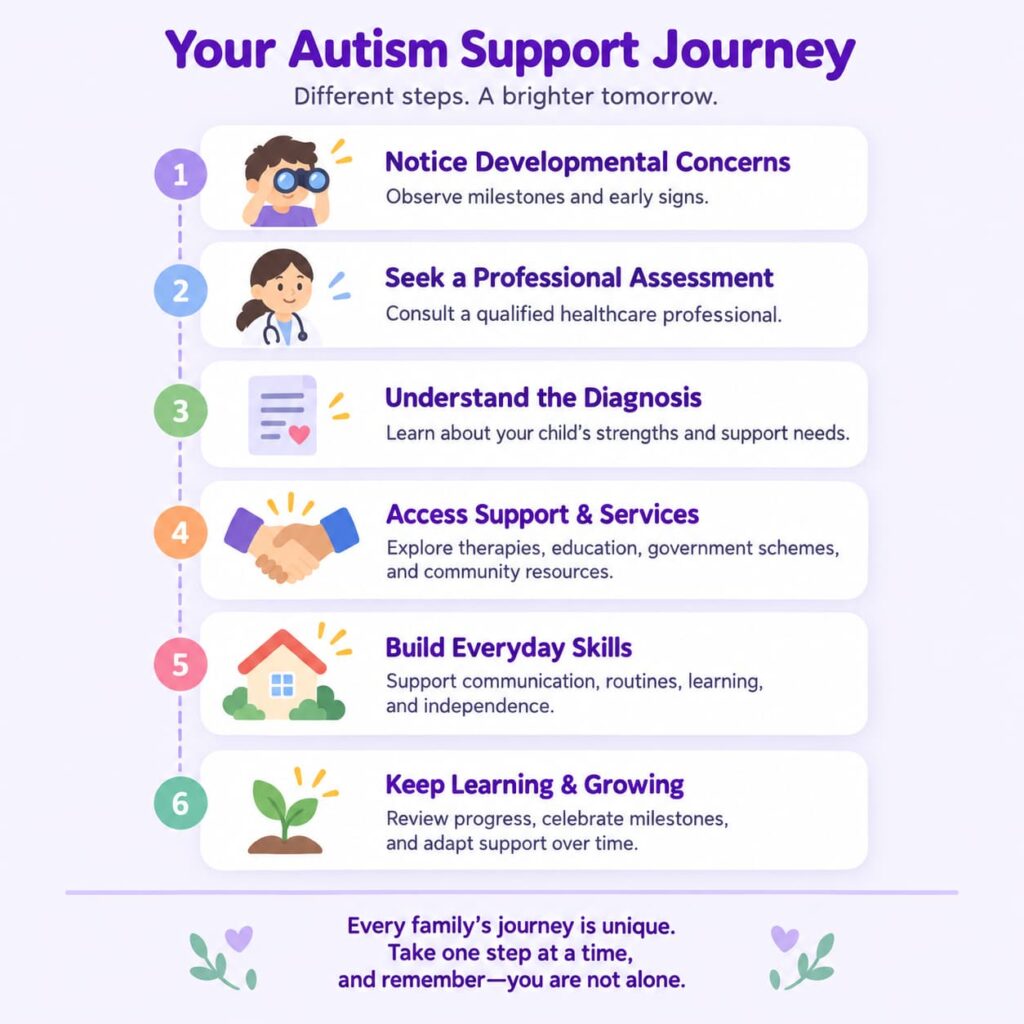
A Practical Autism Resources Roadmap for Indian Parents
If I were starting again from the beginning, I would organise the paperwork roughly like this:
Step 1: Understand the developmental concern
Speak with an appropriate developmental or healthcare professional.
Step 2: Keep copies of assessments
Create one folder containing medical, developmental, therapy and school records.
Step 3: Ask whether disability certification is appropriate
Use an authorised medical authority.
Step 4: Apply for the disability certificate and UDID where appropriate
Use the official UDID system.
Step 5: Check your child’s eligibility for programmes
Look at National Trust schemes, State benefits, education programmes and other official resources.
Step 6: Understand educational rights
Learn the relevant provisions of the RPwD Act and your State’s education system.
Step 7: Verify professionals and organisations
Use RCI and National Trust directories where relevant.
Step 8: Keep adulthood planning in a separate folder
Do not solve adulthood today.
Just keep learning about legal, financial, vocational and residential options as your child grows.
Frequently Asked Questions About Autism Resources in India
1. Is an autism diagnosis enough to receive all government benefits?
No.
Different schemes may require a disability certificate, UDID, a particular disability percentage, income criteria, age criteria or other documents.
Always check the rules for the specific scheme.
2. Does my child need 40% autism disability to get a UDID?
Current DEPwD guidance provides for disability certificates and UDID cards for people assessed below 40% as well. However, benefits specifically reserved for benchmark disability generally involve the 40% threshold defined under the RPwD Act.
3. Does having a UDID mean my child automatically receives money from the government?
No.
UDID is an identification and certification system.
Benefits depend on the rules of each Central or State scheme.
4. Is Niramaya free medical insurance?
Niramaya is a National Trust health-insurance scheme for eligible persons covered under the National Trust Act. It currently provides coverage up to ₹1 lakh on a reimbursement basis, subject to scheme rules, enrolment requirements and sub-limits.
Check the National Trust website for current enrolment costs and terms before applying.
5. Does every autistic adult require legal guardianship?
No.
Support needs vary enormously.
Legal guardianship should relate to the individual’s actual decision-making and support requirements and the applicable legal process, not merely the existence of an autism diagnosis.
6. How do I know whether an autism centre is government recognised?
Ask exactly what registration they claim.
If they claim to be registered with the National Trust, verify them in the National Trust’s official organisation directory.
For regulated rehabilitation professionals, check appropriate professional registration such as the RCI Central Rehabilitation Register where applicable.
7. Can I complain if my child’s disability rights are ignored?
Yes, grievance mechanisms exist.
The appropriate route depends on whether the matter concerns a Central Government-controlled body, State authority, school, employer or another institution. The CCPD handles matters within its jurisdiction, while State-level matters generally go to the respective State Commissioner for Persons with Disabilities.
8. Are benefits the same throughout India?
No.
Central laws and schemes apply nationally, but State Governments may operate additional disability pensions, scholarships, concessions, education support and welfare programmes.
Eligibility and implementation can therefore differ by State.
This is why LeapAgo should eventually create separate guides for states such as Telangana, Karnataka, Maharashtra, Tamil Nadu, Delhi and others.
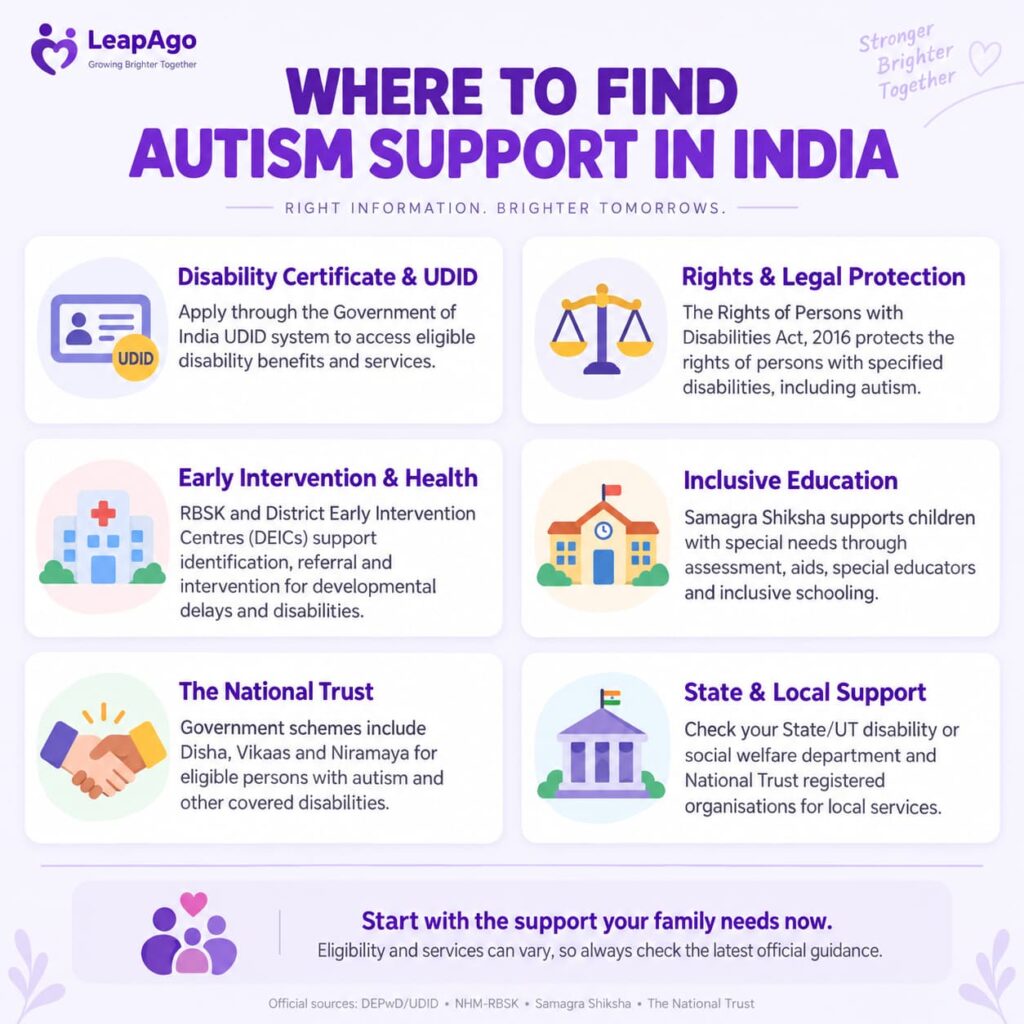
Before You Leave This Page, Save These Seven Names
You do not need to memorise every scheme in this article.
If you remember only seven resources, remember:
DEPwD
For India’s disability laws and official policy.
UDID
For disability certification and Unique Disability ID.
The National Trust
For autism-related welfare schemes, Niramaya and guardianship.
RCI
For regulated rehabilitation-professional qualifications and registration.
Samagra Shiksha
For inclusive school-education support.
NIEPID and other National Institutes
For government disability assessment, rehabilitation and professional services.
Chief/State Commissioner for Persons with Disabilities
For disability-rights grievance mechanisms.
That little list can save a parent hours of wandering through Google.
A Father-to-Parent Note Before We Close This Series
When I started trying to understand my son’s developmental needs, I did not imagine that parenting would involve learning words like developmental assessment, sensory regulation, occupational therapy, disability percentage, UDID, inclusive education and legal guardianship.
Most parents don’t.
We learn because our children need us to.
And sometimes the hardest part is not the diagnosis itself.
It is navigating the maze around it.
A therapy centre says one thing.
A relative says another.
A school tells us something else.
WhatsApp tells us there is a miraculous new programme.
Google gives us 40 tabs.
Government websites use language we have never heard before.
It can become exhausting.
That is why I want this final chapter to leave you with one simple habit:
When the information affects your child’s health, education, rights, money or future, go back to the original source.
For medical questions, ask an appropriate healthcare or developmental professional.
For disability benefits, check the Government source.
For legal rights, read the official law or speak with someone qualified to interpret it.
For professional qualifications, verify them.
For another parent’s experience, listen respectfully, but remember that their child is not your child.
And when you do not know something yet, that is okay.
We are parents.
We are learning too.
We do not have to know every answer today.
We simply need to keep asking better questions, protecting our children from false promises, finding the right support, and helping them build the greatest possible communication, independence, dignity and participation in life.
That is where I would like to end our Autism Complete Guide Series.
Not with a promise that everything will become easy.
But with something more useful:
You now know where to begin looking for reliable answers.
Continue Reading the Autism Complete Guide Series
📖 What’s Included in This Guide
This guide is designed to be read in order. Each part builds on the previous one to help you understand autism and support your child with greater clarity.
○ Part 1 – What Is Autism?
○ Part 2 – Early Signs of Autism
○ Part 3 – Communication and Speech
○ Part 4 – Sensory Processing and Behaviour
○ Part 5 – Understanding Therapies
○ Part 6 – Daily Life with Autism
○ Part 7 – Looking After Yourself as a Parent
○ Part 8 – Frequently Asked Questions
📍YOU ARE HERE
Part 9 – Autism Resources in India
Current Article
🎉 You’ve Reached the End of the Autism Guide
Congratulations! You’ve completed the Complete Autism Guide for Indian Parents. I hope this guide has helped you better understand autism and feel more confident about supporting your child.
Learning doesn’t end here. As your child grows, you’ll have new questions, and LeapAgo will continue to grow with you.
🌱 Continue Exploring LeapAgo
If you’d like to learn more, you may also find these guides helpful:
- Autism Therapies Explained
- Sensory Activities for Kids
- Speech Delay vs Autism
- School Readiness
- Parent Stories
Sources Consulted and Verified
Information in this article was checked against current material from:
- Department of Empowerment of Persons with Disabilities, Government of India
- India Code and the Rights of Persons with Disabilities Act, 2016
- Unique Disability ID / Swavlamban Card portal
- The National Trust
- Rehabilitation Council of India
- Office of the Chief Commissioner for Persons with Disabilities
- Samagra Shiksha
- Government National Institutes including NIEPID
- Action For Autism
- Autism Society of India
Government scheme details were checked against sources available in September 2026. Parents should recheck the official pages before applying because programme rules, benefit limits, contact information and eligibility criteria can change.
Affiliate Disclosure
This article does not recommend affiliate products because its purpose is to help parents understand public rights, government schemes and reliable support resources.
Other LeapAgo articles may contain affiliate links to relevant books, visual-support materials or practical parenting resources. Where such links appear, they will be clearly disclosed. Affiliate relationships do not change the educational information we provide.