
💡 Ready for the next step?
Now that we’ve explored why behaviors happen, let’s look at the therapies and supports that can help children build communication, independence, and everyday life skills. In Part 5, we’ll explore Occupational Therapy, Speech Therapy, ABA, Special Education, Parent Coaching, and how to make informed decisions without chasing miracle solutions.
There Isn’t One “Best” Therapy
One of the first things that happened after we began seeking support for Suhas was this.
Everyone had advice.
Friends.
Relatives.
Teachers.
Therapists.
Even people who had never met our son.
One person would say,
“Occupational Therapy is the answer.”
Another would say,
“Speech Therapy should come first.”
Someone else would insist,
“ABA is the only thing that works.”
If I’m being honest, it became overwhelming.
As parents, we naturally want to do everything possible for our children.
But when every person gives different advice, it’s easy to feel confused and even guilty.
Over time, I learned something that completely changed how I looked at therapy.
The question isn’t:
“Which therapy is the best?”
The better question is:
“Which skills does my child need the most support with right now?”
That shift helped us make calmer, more informed decisions.
What Is the Purpose of Therapy?
Before we talk about specific therapies, I want us to remember something important.
Therapy is not about changing who a child is.
It is about helping a child:
- Communicate more effectively.
- Participate in family life.
- Become more independent.
- Develop everyday skills.
- Learn in ways that suit them.
- Reduce frustration.
- Improve quality of life.
Different therapies focus on different goals.
That’s why many children receive more than one type of support.
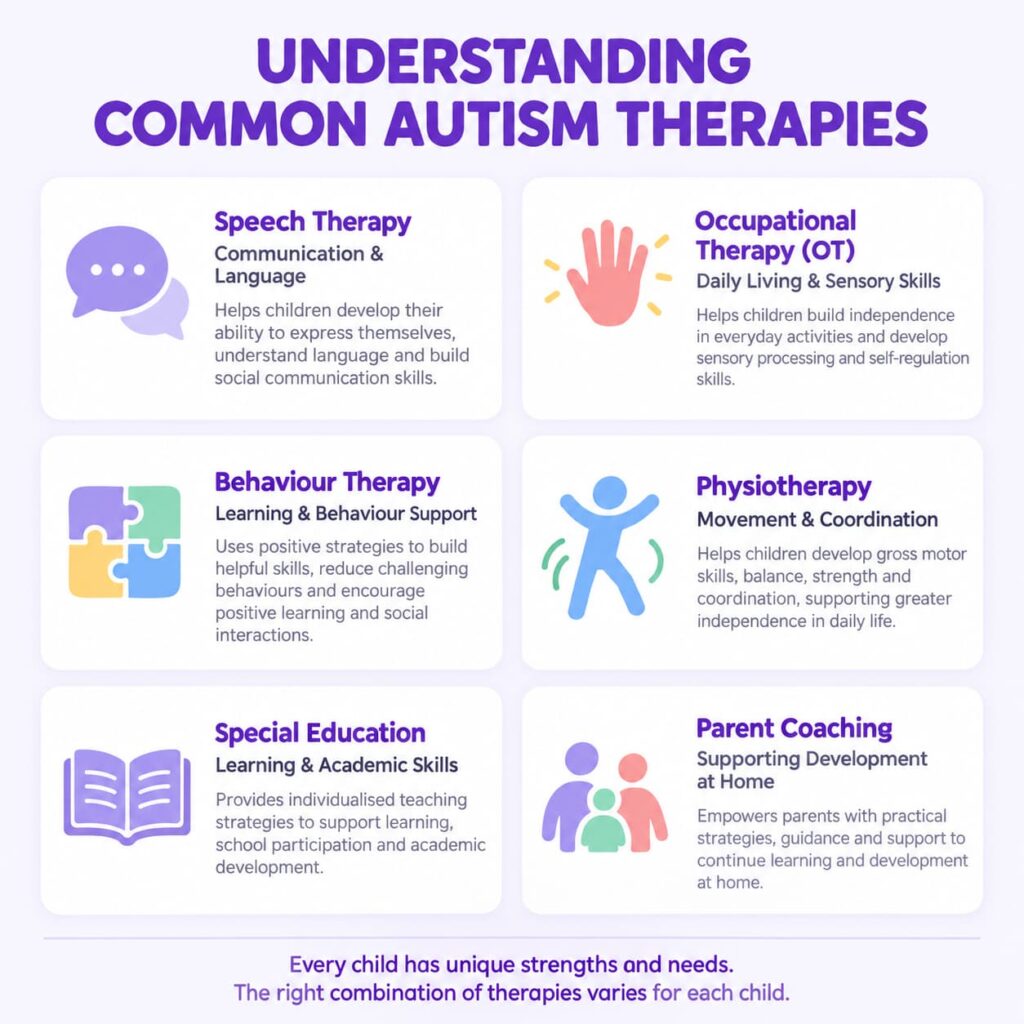
Occupational Therapy (OT)
If there’s one therapy that completely changed how I understood autism, it was Occupational Therapy.
Before we started, I honestly thought OT helped children learn jobs.
The name is confusing.
In reality, Occupational Therapy for children focuses on the “occupations” of childhood—the everyday activities children need to participate in.
That includes:
- Playing
- Eating
- Dressing
- Writing
- Sitting
- Climbing
- Using hands
- Paying attention
- Managing sensory experiences
- Becoming more independent
What Does an Occupational Therapist Do?
An Occupational Therapist (OT) looks at how a child functions in daily life.
Rather than asking,
“Can this child complete the task?”
They ask,
“What’s making this task difficult?”
For example:
If a child refuses to wear shoes…
An OT might explore whether the child is experiencing sensory discomfort.
If a child struggles to sit for five minutes…
The therapist may look at posture, body awareness, movement needs, or sensory regulation.
The goal is to understand the underlying reason—not simply the behaviour.
Common Areas OT Can Help With
Occupational Therapy may support children with:
- Sensory processing differences
- Fine motor skills
- Gross motor coordination
- Handwriting readiness
- Self-care skills
- Dressing
- Feeding skills
- Emotional regulation
- Attention
- Play skills
Every therapy plan should be individualized.
What This Looked Like in Our Home
One of the biggest changes we noticed with Suhas wasn’t that a difficult behaviour suddenly disappeared.
Instead, we started understanding why certain behaviours happened.
For example, when he constantly sought movement, OT helped us see that his body was asking for sensory input.
Instead of saying,
“Stop jumping.”
We learned to provide safe, structured movement opportunities throughout the day.
The progress wasn’t instant.
It happened gradually.
But our understanding changed much faster than the behaviours themselves.
And that made us respond very differently as parents.
Speech Therapy
For many parents, speech is one of the first concerns after a diagnosis.
Questions like:
“Will my child ever speak?”
“How can I help?”
are completely natural.
Speech Therapy is about much more than producing words.
A Speech-Language Pathologist (SLP) helps children develop functional communication.
That may include:
- Understanding language
- Expressing needs
- Using gestures
- Conversation skills
- Play-based communication
- Social communication
- Feeding and oral-motor skills (for some children)
Communication Before Words
One of the biggest lessons I learned is that communication starts long before speech.
A child who points…
Looks at you…
Brings you a toy…
Uses pictures…
Or signs…
Is already communicating.
Speech therapy often builds on those early communication skills rather than focusing only on spoken words.
How Parents Can Support Speech at Home
The therapy session is only one part of the week.
Real learning happens during everyday life.
Simple things like:
- Reading picture books.
- Singing songs.
- Offering choices.
- Waiting for communication.
- Playing together.
- Narrating daily routines.
can create hundreds of communication opportunities every week.
Parents become part of the therapy team.
Applied Behavior Analysis (ABA)
Few therapies create as much discussion among parents as Applied Behavior Analysis (ABA).
You’ll hear very different opinions.
Some families report positive experiences.
Others have concerns based on how ABA was delivered or on its goals.
Because of this, it’s important to understand that ABA is not one single program. Different providers may use different approaches.
Modern, evidence-based ABA often focuses on:
- Teaching communication skills.
- Daily living skills.
- Play skills.
- Social interaction.
- Learning readiness.
- Reducing behaviours that interfere with safety or participation.
Many contemporary practitioners also emphasize child engagement, positive reinforcement, and individualized goals.
Questions Parents Can Ask
If you’re considering ABA, you might ask:
- What goals will you work on?
- How are goals chosen?
- How do you involve parents?
- How do you measure progress?
- How do you respect my child’s preferences and communication?
- How do you respond when my child is distressed?
Good therapy should feel like a partnership—not something done to your child without your involvement.
Special Education
Not every child learns in the same way.
Some children benefit from extra support with:
- Academic skills.
- Attention.
- Following instructions.
- Classroom participation.
- Daily routines.
- Social learning.
Special educators adapt teaching methods to match a child’s learning style.
Sometimes learning looks very different from a traditional classroom—and that’s okay.
The goal isn’t simply to finish a curriculum.
The goal is meaningful learning.
Skills Often Taught
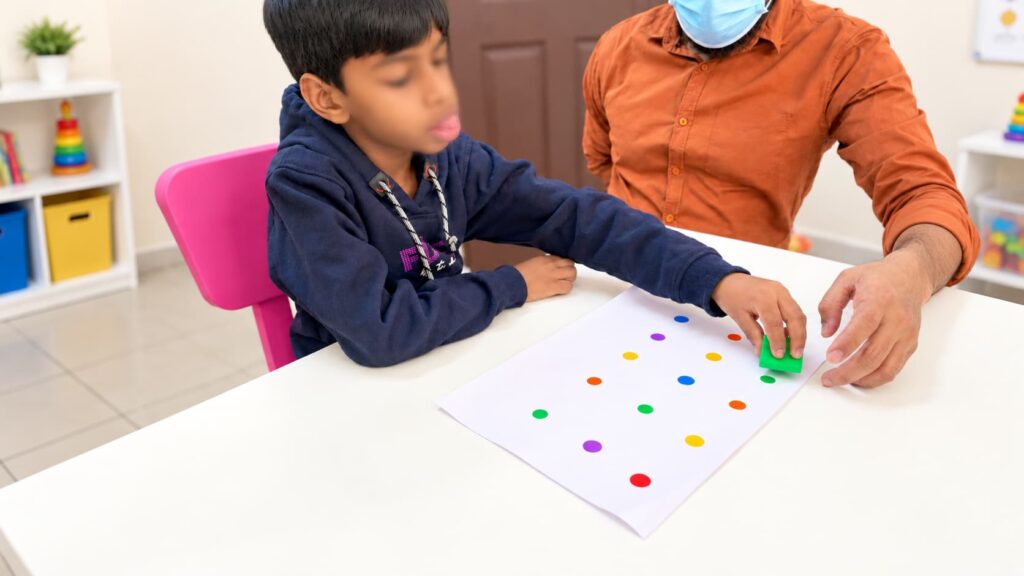
Special education may include:
- Pre-academic skills.
- Reading readiness.
- Writing readiness.
- Number concepts.
- Functional communication.
- Daily living skills.
- Classroom routines.
- Independence.
Many of these skills become the foundation for later learning.
Parent Coaching
If I could go back and change one thing about our own journey, it would be this.
I would have asked for more parent coaching earlier.
Because here’s something I eventually realized.
Even if Suhas had five therapy sessions every week…
He still spent far more time with us than with any therapist.
Parents become the child’s most consistent teachers.
Not because we’re professionals.
But because we’re present.
What Is Parent Coaching?
Parent coaching isn’t about judging parents.
It’s about helping families:
- Understand their child’s needs.
- Use strategies during everyday routines.
- Build confidence.
- Reduce stress.
- Create realistic goals.
The best coaching empowers parents rather than making them feel dependent on professionals.
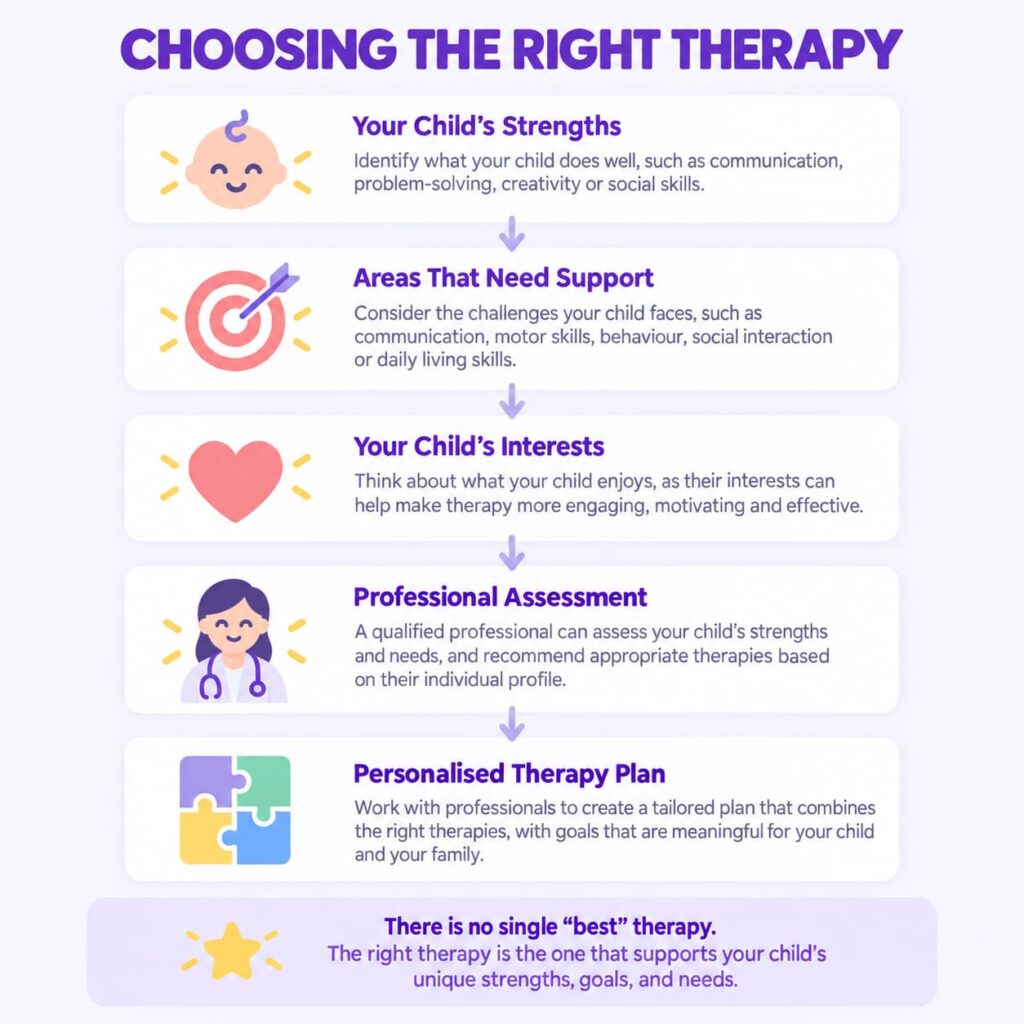
How to Build the Right Therapy Team
Instead of asking,
“Which therapy should we choose?”
Try asking:
- What are our child’s biggest strengths?
- What skills would improve daily life the most?
- Which professional can help us work toward those goals?
- How can we continue these strategies at home?
Therapies should work together.
Not compete with each other.
What Research Tells Us
Organizations such as the American Academy of Pediatrics (AAP), the CDC, NIEPID, and other developmental experts consistently emphasize:
- Early support can help children develop communication, participation, and everyday skills.
- Interventions should be individualized.
- Families should be actively involved.
- Goals should focus on meaningful participation and quality of life.
- Progress looks different for every child.
No single therapy is right for every autistic child.
The best plan is one built around the individual child.
Key Takeaways
If there’s one message I hope you remember, it’s this:
Therapy is not a race.
You don’t need to chase every new program.
You don’t need to compare your child’s therapy schedule with another family’s.
Choose support based on your child’s current needs.
Review progress regularly.
Stay involved.
And remember that the hours you spend playing, talking, reading, eating, and living life together are just as important as the hours spent in a therapy room.
💙 A Note From One Parent to Another
When we first started this journey, I thought therapy would provide all the answers.
Today, I see it differently.
Therapists have given us knowledge, guidance, and practical strategies.
But they’ve also helped us become better parents.
The biggest progress didn’t happen because someone worked with Suhas for an hour.
It happened because we slowly learned how to support him during the other twenty-three hours of the day.
Don’t underestimate your role.
Your love.
Your patience.
Your willingness to keep learning.
Those may become some of the most powerful “therapies” your child ever receives.
—
Sridhar K
Founder, LeapAgo
📖 What’s Included in This Guide
This guide is designed to be read in order. Each part builds on the previous one to help you understand autism and support your child with greater clarity.
○ Part 1 – What Is Autism?
○ Part 2 – Early Signs of Autism
○ Part 3 – Communication and Speech
○ Part 4 – Sensory Processing and Behaviour
📍YOU ARE HERE
Part 5 – Understanding Therapies
Current Article
○ Part 6 – Daily Life with Autism
○ Part 7 – Looking After Yourself as a Parent
○ Part 8 – Frequently Asked Questions
○ Part 9 – Autism Resources in India