

We’ve Come a Long Way Together
If you’ve read this guide from beginning to end, I first want to say…
Thank you.
Thank you for trusting me with your time.
I know how precious your time is.
As parents, we don’t usually sit down and read thousands of words unless we’re searching for something important.
Maybe you’ve been looking for answers.
Maybe reassurance.
Maybe practical ideas.
Maybe simply someone who understands.
I sincerely hope you’ve found at least one of those things here.
OK. Now let’s talk about the FAQs (Frequently Asked Questions).
Honest, Simple Answers to the Questions Parents Ask Most
When parents first begin learning about autism, the questions rarely arrive neatly one at a time.
They come all together.
“Is speech delay autism?”
“My child looks into my eyes. Can he still be autistic?”
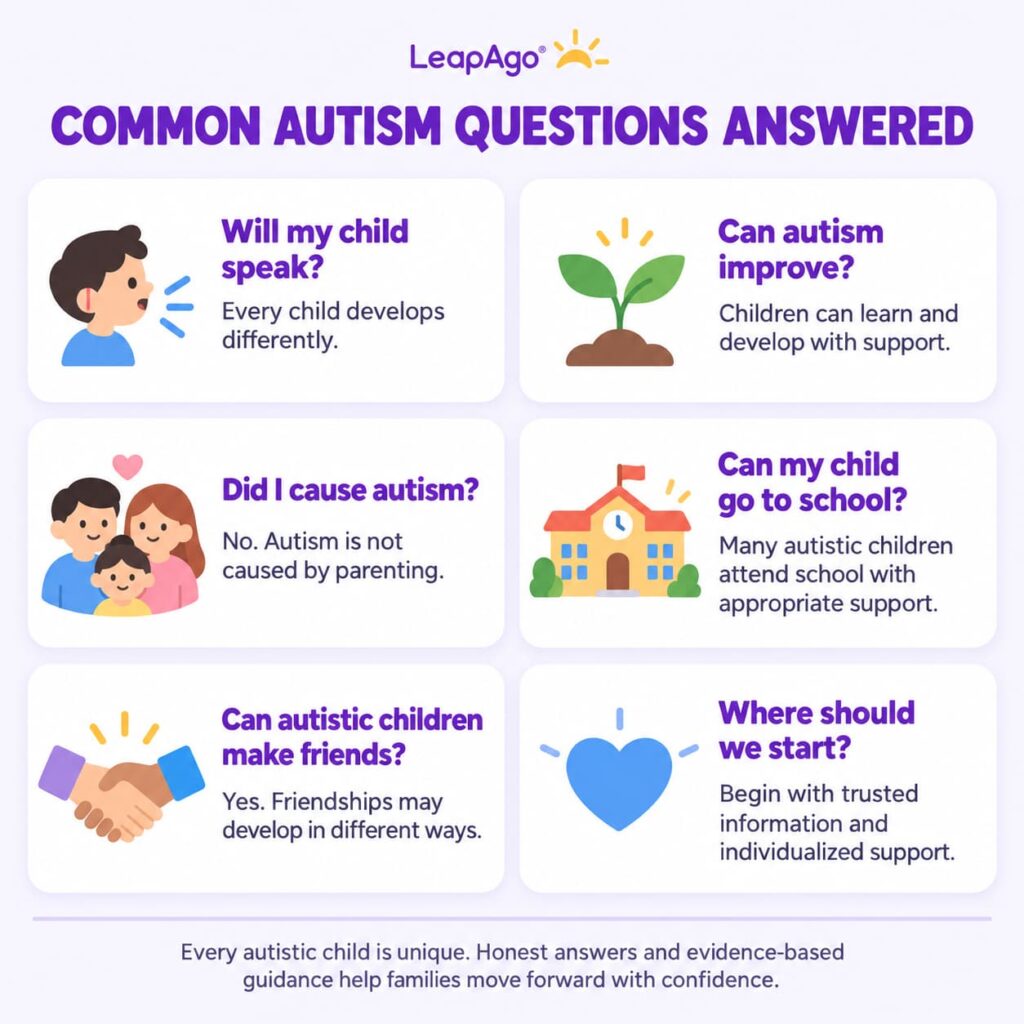
“Will my child ever talk?”
“Did we do something wrong?”
“Should I start therapy immediately?”
“Can my child go to a regular school?”
“What will happen when my child grows up?”
I understand why we search for clear answers. When something concerns our child, uncertainty can feel heavier than the answer itself.
But autism is one of those subjects where simple yes-or-no answers can sometimes mislead parents.
Children develop differently. Autism also presents differently from one person to another. One behaviour does not diagnose autism, and the absence of one commonly discussed behaviour does not rule it out either.
So in this part of our Complete Guide to Autism, I want to answer the questions parents commonly ask in the simplest, most practical way I can.
Not as a doctor.
Not as someone claiming to have every answer.
But parent to parent.
I am a parent sharing personal experiences and educational information, not a doctor or therapist. This article is not intended to diagnose any child or replace advice from a qualified healthcare or developmental professional.
Understanding Autism
1. What exactly is autism?
Autism, or autism spectrum disorder, is a neurodevelopmental condition related to how the brain develops.
It can affect areas such as social communication, interaction, behaviour, sensory experiences, routines, learning, attention and everyday functioning.
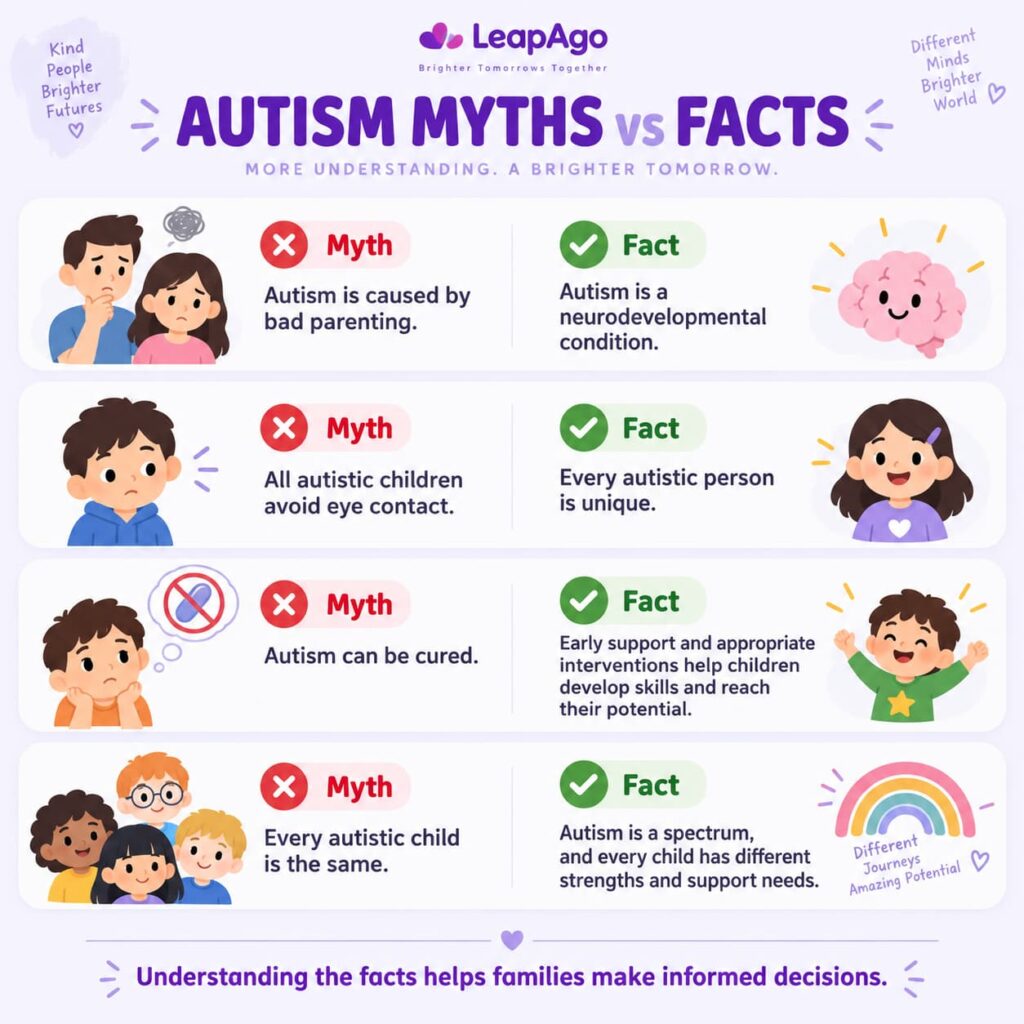
The word spectrum matters because autistic people are not all the same.
One child may communicate using sentences but struggle with social situations and sensory overload.
Another may use only a few spoken words and need substantial help with everyday activities.
Another may have strong academic abilities but find change, friendships or communication extremely difficult.
WHO describes autism as a diverse group of conditions associated with differences in social interaction and communication, along with patterns of behaviour, activities or interests that may differ from what is typically expected.
Autism tells us something about a person’s development.
It does not tell us everything about that person.
2. What does “autism spectrum” actually mean?
Sometimes parents imagine the autism spectrum as a straight line:
Mild autism ←————→ Severe autism
It is much more complicated than that.
A child can need very little assistance in one area and significant assistance in another.
For example, a child might:
communicate verbally but need help with daily living,
have excellent memory but struggle with flexible thinking,
enjoy people but not understand how to join a conversation,
manage beautifully at home but become overwhelmed at school,
or need considerable communication support while being very capable in other areas.
WHO notes that the abilities and support needs of autistic people vary considerably and can also change over time.
That is why I prefer thinking about a child’s individual strengths and support needs rather than trying to squeeze the child into one simple label.
3. Is autism a disease?
Autism is generally described as a neurodevelopmental condition or developmental disability, not an infection or illness that a child catches.
An autistic child is not “sick with autism.”
That distinction matters because it changes the question from:
“How do we remove autism?”
to:
“What support does this child need to communicate, learn, participate and live as independently as possible?”
4. Can autism be cured?
There is currently no recognised “cure” for autism, and parents should be cautious about anyone promising one.
Autism is considered lifelong.
That does not mean a child’s abilities remain frozen.
Children can learn.
Communication can develop.
Daily living abilities can improve.
Behaviour can change.
A child may become better able to regulate emotions, participate in school, communicate needs or perform everyday activities.
WHO notes that appropriate psychosocial interventions can support communication, social abilities and quality of life, but outcomes and support needs vary considerably between individuals.
I would be particularly careful with advertisements promising things such as:
“Reverse autism.”
“Recover your child completely.”
“Guaranteed speech.”
“Cure autism naturally.”
Parents are especially vulnerable to these promises because we naturally want to help our children.
Hope is important.
But hope should come with honesty.
Causes and Common Worries
5. Did something we did as parents cause autism?
This is one question I wish parents did not have to carry.
Autism is not caused by bad parenting.
It is not because you did not speak enough to your child.
It is not because you worked outside the home.
It is not because you were too strict.
It is not because you were too lenient.
It is not because you did not play perfectly.
Current scientific evidence suggests that autism develops through a complex combination of genetic and biological factors influencing early brain development. There is no single cause that explains every autistic person’s development.
Parents already have enough practical work ahead of them.
We do not need unnecessary guilt sitting beside us.
6. Do vaccines cause autism?
No.
Extensive research has found no causal relationship between vaccines and autism.
WHO reviewed the evidence again in 2025, including research published between 2010 and 2025, and reaffirmed that high-quality evidence does not show that childhood vaccines cause autism.
This myth has survived far longer than the evidence supporting it, which is unfortunate because it can create fear around both autism and vaccination.
If you have specific concerns about vaccines or your child’s medical history, discuss them with your paediatrician rather than relying on social-media claims.
7. Is autism caused by screen time or mobile phones?
Parents frequently worry about this.
Current medical understanding does not identify ordinary screen exposure as a proven cause of autism.
Heavy screen use can affect how children spend their time. For example, excessive screen use may replace opportunities for sleep, physical activity, interaction and play.
But that is different from saying:
“Screens caused my child’s autism.”
We should avoid confusing an association, behaviour or lifestyle factor with a proven cause.
If screen use is affecting your child’s sleep, play, interaction or family routine, you can certainly discuss healthy limits with your paediatrician.
But parents should not blame themselves for “causing autism” because a child watched cartoons.
Signs and Development
8. What are some early signs parents may notice?
Possible autism-related differences can appear in communication, social interaction, play, repetitive behaviour, sensory responses or flexibility.
Parents might notice things such as limited use of gestures, inconsistent response to name, difficulty with back-and-forth interaction, repetitive movements, unusually intense interests, difficulty with changes or unusual sensory responses.
But this is extremely important:
Children without autism can show some of these behaviours too.
CDC explicitly notes that some non-autistic people can show characteristics also associated with autism. Diagnosis depends on the broader developmental pattern and how characteristics affect everyday functioning.
This is why internet checklists are useful for organising questions, but not for diagnosing a child.
9. Is speech delay always autism?
No.
A child can have speech or language delay without being autistic.
Speech delay may occur for many reasons.
Autism involves more than how many words a child can say.
Professionals also consider social communication, gestures, shared attention, interaction, play, repetitive behaviour, sensory patterns and the child’s overall developmental history.
Similarly, an autistic child does not necessarily have obvious speech delay.
NICE specifically warns that autism should not be ruled out simply because a child has achieved apparently typical language milestones.
So instead of asking only:
“How many words does my child know?”
it may also help to ask:
“How does my child use communication with other people?”
10. My child makes good eye contact. Does that mean it is not autism?
No.
Good eye contact does not automatically rule out autism.
This is one of the most common misunderstandings parents encounter.
NICE specifically advises professionals not to rule out autism because a child makes good eye contact, smiles or shows affection to family members.
Some autistic children make limited eye contact.
Some make brief eye contact.
Some make frequent eye contact.
Some may have learned to use eye contact socially even when it feels uncomfortable.
Eye contact is only one small piece of a much larger developmental picture.
11. My child responds to their name sometimes. Can autism still be possible?
Yes.
Development is rarely as simple as “always” or “never.”
A child may respond in one environment but not another.
They may respond when the room is quiet but not when deeply focused on an activity.
They may respond to a familiar parent more consistently than to another person.
Inconsistent response to name can be one observation worth discussing, but it cannot diagnose autism by itself.
Hearing should also be considered when a child frequently does not respond to spoken communication.
12. My child lines up toys. Does that mean autism?
No.
One repetitive behaviour cannot diagnose autism.
Some children enjoy arranging toys.
Some love routines.
Some flap their hands when excited.
Some spin objects.
Some repeat favourite songs.
The question is not whether one behaviour exists.
Professionals consider the overall pattern, how persistent it is, whether other developmental differences are present, and whether the behaviours meaningfully affect everyday functioning.
I would never want a parent to see one behaviour on Instagram and suddenly become convinced that their child has autism.
Observe patterns, not isolated moments.
13. Can an autistic child be affectionate?
Absolutely.
Autism does not mean a child cannot love their parents or enjoy affection.
Some autistic children seek hugs constantly.
Some prefer affection only from familiar people.
Some dislike unexpected touch.
Some may want closeness but express it differently.
A child’s way of showing affection is not a test for autism.
NICE specifically warns against ruling out autism simply because a child smiles or shows affection toward family members.
14. Can children lose skills they previously had?
Some children may experience regression, such as losing previously used language or social abilities.
Loss of skills deserves professional attention.
NICE recommends referral when young children show regression in language or social abilities, and recommends medical evaluation when motor skills are lost.
If your child suddenly loses previously established skills, I would not simply wait several months hoping they return.
Bring the change to a paediatrician or appropriate developmental professional.
Screening and Diagnosis
15. At what age can autism be diagnosed?
Characteristics of autism can sometimes be noticed during toddlerhood.
The CDC states that autism can sometimes be detected by around 18 months or earlier and that, by age two, an assessment performed by an experienced professional can be considered reliable in many cases.
But many autistic children are identified later.
Some characteristics become clearer only when social, communication and school demands increase.
So there is no rule saying:
“If autism was not diagnosed by age three, it cannot be autism.”
16. When is autism screening recommended?
The American Academy of Pediatrics recommends developmental surveillance throughout childhood, general developmental screening at particular well-child visits, and autism-specific screening at around 18 and 24 months.
Additional screening may be appropriate whenever parents or professionals have developmental concerns.
Screening, however, is not the same as diagnosis.
17. What is the difference between autism screening and diagnosis?
Think of screening as asking:
“Should we look more carefully?”
Diagnosis asks:
“After a detailed evaluation, does this child’s developmental profile meet the criteria for autism?”
Screening tools can identify children who may need further assessment.
A positive screening result does not automatically mean autism.
Likewise, a screening questionnaire alone should not be used by parents to diagnose their child.
CDC explains that diagnosis relies on developmental history and behaviour rather than one medical test.
18. Is there a blood test, MRI or brain scan that diagnoses autism?
No single blood test, MRI or other medical test can currently diagnose autism.
Autism assessment is primarily based on developmental history and observation of behaviour and communication.
A doctor may sometimes recommend additional medical investigations when there are other concerns, but those investigations are not the autism diagnosis itself.
19. Who can diagnose autism?
This can vary depending on the healthcare system and country.
An autism evaluation may involve professionals such as developmental paediatricians, paediatricians experienced in development, child psychiatrists, clinical psychologists, speech-language professionals and other members of a multidisciplinary developmental team.
In India, parents may encounter many different job titles, which can become confusing.
One practical step is to ask:
“What are your qualifications?”
“Who is responsible for the formal diagnosis?”
“What assessment is being conducted?”
“Will I receive a written report?”
For rehabilitation and special-education professionals in India, parents can also check whether relevant professionals hold recognised qualifications and valid registration where required through the Rehabilitation Council of India. RCI maintains a Central Rehabilitation Register for recognised categories of rehabilitation professionals.
20. Should I get a second opinion?
If you remain unsure about an assessment, the findings do not seem to reflect what you observe across different settings, or the recommendations are unclear, seeking another qualified opinion can be reasonable.
A second opinion does not mean disrespecting the first professional.
Sometimes parents simply need better understanding.
Bring previous reports, school observations, therapy notes and relevant developmental history so the next professional has useful context rather than starting completely from zero.
Autism, Speech and Communication
21. Will my autistic child eventually speak?
No one can responsibly promise this for an individual child.
Some autistic children develop fluent spoken language.
Some develop a smaller amount of speech.
Some communicate primarily through alternative or augmentative methods.
Some use a combination.
The more useful goal is often not simply:
“Make my child talk.”
It is:
“Help my child communicate effectively.”
That communication may include speech, gestures, pictures, signs, communication boards or speech-generating technology depending on the individual’s needs.
22. What is echolalia?
Echolalia means repeating words or phrases that another person has said or that the child has heard elsewhere.
For example, a child may repeat part of a cartoon, a familiar question or a sentence heard earlier.
NICE includes repeated words and phrases among language characteristics that may occur in autistic children.
Rather than automatically trying to stop all repetition, it may be useful to work with a qualified speech-language professional to understand whether the child is communicating, practising language, regulating themselves or using repeated phrases for another purpose.
23. Will using AAC stop my child from learning to speak?
Parents sometimes worry that giving a child another communication method will make them “lazy” about speech.
Research does not support the idea that AAC prevents speech development.
Systematic reviews published through the American Speech-Language-Hearing Association have found that AAC does not appear to suppress speech production; some studies found increases in speech, although speech gains vary widely and should not be promised.
AAC should be considered communication, not failure.
A child being able to say “water,” “pain,” “break,” “toilet” or “I don’t want this” through any reliable communication method can be enormously important.
Behaviour, Sensory Needs and Regulation
24. What is stimming?
“Stimming” is a common informal term for repetitive movements, sounds or actions.
Examples may include rocking, hand movements, pacing, repeating sounds or interacting with objects repetitively.
Not every repetitive action needs to be eliminated.
Instead I would ask:
Is it dangerous?
Is the child hurting themselves?
Is it stopping them from completing something genuinely important?
Or is it simply a harmless way of regulating, expressing excitement or processing sensory input?
The answer matters.
A behaviour that looks unusual to us is not automatically a behaviour that needs to disappear.
25. Are sensory difficulties part of autism?
Sensory differences are common among autistic people.
Some children may be highly sensitive to sound, touch, light, textures, tastes or smells.
Others may actively seek movement, pressure or particular sensory experiences.
WHO includes unusual reactions to sensations among characteristics that may occur with autism.
But sensory differences alone do not diagnose autism.
They can occur in people with other developmental conditions and in people who are not autistic.
26. Is every meltdown a tantrum?
No.
A child may cry, scream, drop to the floor or become physically distressed for very different reasons.
Sometimes behaviour may be related to wanting access to something.
At other times a child may be overwhelmed by noise, communication difficulty, unexpected change, frustration, tiredness, sensory overload or demands they cannot manage.
Instead of focusing only on:
“How do I stop this behaviour?”
it can be helpful to ask:
“What happened before it?”
“What might my child be trying to communicate?”
“What support might prevent the same situation next time?”
Safety still matters.
Understanding the reason does not mean ignoring dangerous behaviour.
It means trying to respond more intelligently rather than assuming every difficult moment is deliberate disobedience.
27. Can autism and ADHD occur together?
Yes.
Autism and ADHD are different neurodevelopmental conditions, but they can occur in the same person.
WHO lists ADHD among conditions that can co-occur with autism.
This is important because hyperactivity, impulsivity or difficulty sustaining attention should not automatically be assumed to be “just autism.”
If those difficulties significantly affect everyday functioning, discuss them with an appropriate professional.
28. Are sleep or eating difficulties common in autistic children?
Some autistic children experience significant sleep or feeding difficulties.
The American Academy of Pediatrics notes that autistic children can also have co-occurring concerns involving sleep, feeding, gastrointestinal symptoms, ADHD, anxiety, seizures and other areas.
But parents should not automatically assume every sleep or eating problem is caused by autism.
Pain, gastrointestinal problems, allergies, sleep disorders, dental problems and other medical issues still deserve normal medical attention.
Autism should never become a reason to ignore a child’s physical health.
Learning and Intelligence
29. Does autism mean intellectual disability?
No.
Autism and intellectual disability are different.
They can occur together, but not every autistic person has intellectual disability.
WHO notes that intellectual ability among autistic people ranges widely, from significant impairment to superior intellectual functioning.
A child’s ability should therefore be assessed individually.
We should also be careful not to underestimate someone simply because spoken communication is limited.
Communication ability and intelligence are not the same thing.
30. Can an autistic child learn academics?
Yes, many autistic children learn academic skills.
But children vary enormously in how, what and how quickly they learn.
Some may follow an age-level academic curriculum.
Some may need adapted teaching.
Some may have uneven abilities, such as being strong in reading or memory but struggling with comprehension, handwriting, attention or classroom participation.
For another child, communication, safety and independence may currently be more meaningful priorities than academic performance.
The right question is not:
“Can autistic children learn?”
It is:
“How does this child learn best, and what support allows meaningful participation?”
School Questions
31. Can an autistic child attend a mainstream school?
Many autistic children attend mainstream or inclusive schools.
Others may benefit from specialised settings or combinations of supports.
There is no single educational setting that is automatically best for every autistic child.
Consider the child’s communication, safety, sensory needs, learning profile, independence, classroom size and available support.
In India, Samagra Shiksha includes provisions intended to support inclusive education for children with special needs, including assessment, assistive support, teaching materials, special educators and reasonable accommodation according to individual requirements.
A school name or label matters less than whether the environment can genuinely support the individual child.
32. Should I tell my child’s teacher about autism?
In most situations, giving the school relevant information can make support easier.
The teacher may need to understand things such as:
how your child communicates,
what situations are overwhelming,
how transitions are managed,
how the child asks for a break,
safety concerns,
sensory needs,
toileting support,
attention difficulties,
and strategies that already work at home.
The goal is not to hand the school a diagnosis and say, “You handle everything.”
It is to build a shared understanding of the child.
Therapy and Intervention
33. What is the best therapy for autism?
There is no single therapy that is automatically best for every autistic child.
Support should be selected according to the child’s actual needs.
One child may need substantial communication support.
Another may need occupational therapy for everyday participation.
Another may need educational support.
Another may need help with behaviour, anxiety, feeding or daily living.
The important questions are:
What skill are we working on?
Why is this goal important?
How will progress be measured?
Is the approach respectful and safe?
Can the child use the skill outside the therapy room?
And does the provider have appropriate qualifications?
Autism support should not become a competition to collect as many therapies as possible.
34. How many hours of therapy does my child need?
There is no universal number that suits every child.
More hours are not automatically better.
A child’s age, needs, health, school schedule, tolerance, family situation, goals and professional recommendations all matter.
Children also need time for:
sleep,
family,
play,
movement,
school,
relationships,
ordinary childhood experiences,
and simply doing nothing sometimes.
Instead of asking only:
“How many therapy hours are we doing?”
ask:
“Are these hours helping with meaningful goals?”
35. How do I know whether therapy is actually helping?
Before beginning a service, understand the goal.
“Improve autism” is too vague.
“Improve behaviour” is too vague.
A clearer goal might be:
communicate when a break is needed,
participate in toothbrushing,
follow a short classroom routine,
wait safely near a road,
put on a shirt with less assistance,
or communicate the need to use the toilet.
Then ask periodically:
What was the starting point?
What has changed?
Does the skill occur outside therapy?
Can the family see the change?
Is the goal still meaningful?
Progress does not have to be dramatic to matter.
But parents deserve more than “therapy is going well.”
36. Should I change therapies if progress is slow?
Not automatically.
Development can be gradual.
But you should understand what is being worked on and how progress is being reviewed.
If months pass and you cannot understand the goals, the provider cannot explain what they are measuring, or your child’s distress is consistently being ignored, it is reasonable to ask questions.
Changing therapists constantly can also make it difficult to judge what is helping.
Try to make decisions based on clear goals and evidence rather than panic.
Home and Family
37. What can parents do at home?
You do not have to turn your home into a therapy centre.
Home is still home.
You can support development through ordinary daily routines.
Getting dressed can practise independence.
Snack time can create communication opportunities.
A trip downstairs can practise waiting.
Play can support interaction.
Visual routines can make transitions easier.
Household activities can build practical skills.
The aim is not to spend every waking hour correcting your child.
Often the most useful skills are the ones that make everyday family life easier and give the child greater independence.
38. Should we stop repetitive interests or favourite topics?
Not simply because they look unusual.
A strong interest can sometimes become a bridge for learning, interaction and motivation.
If a child loves trains, animals, numbers, maps or a particular character, that interest may sometimes be incorporated into reading, communication or play.
Intervention becomes more important when an activity is unsafe, severely restricts daily functioning or prevents the child from participating in essential activities.
Difference does not automatically equal problem.
Future Questions
39. Will autism become worse as my child grows?
Autism is lifelong, but abilities and support needs can change.
A child may gain communication and independence.
At the same time, new challenges may appear as social, academic and daily-life expectations increase.
WHO specifically notes that autistic people’s abilities and support needs can evolve over time.
So development is not necessarily a straight line.
There can be progress, plateaus, new difficulties and new strengths.
Instead of trying to predict your child’s entire adulthood from what you see at age three, five or eight, focus on the next meaningful skills.
40. Can an autistic person live independently as an adult?
Some autistic adults live independently.
Some live with varying amounts of support.
Others require substantial lifelong assistance.
There is no honest way to predict every young child’s adult independence with certainty.
WHO acknowledges this wide variation in support needs.
For parents, the most productive response to future anxiety is often to slowly build practical skills:
communication,
personal safety,
self-care,
decision-making,
money awareness when appropriate,
community participation,
household skills,
and the ability to ask for help.
Independence does not have to mean doing everything without another human being.
We all depend on people.
The real goal is often maximum possible autonomy, dignity and participation for that individual.
India-Specific Questions
41. Is autism officially recognised as a disability in India?
Yes.
India has formal guidelines for the assessment and certification of autism, and autism is included within the country’s disability framework.
The Department of Empowerment of Persons with Disabilities publishes official guidelines for autism assessment and certification.
A clinical diagnosis, disability assessment and disability certificate are related but not necessarily identical processes.
Parents should check the current official requirements applicable to their child and location.
42. What is a UDID card, and does every autistic child need one?
UDID stands for Unique Disability ID.
It is part of India’s system for disability identification and access to certain government schemes and services.
Whether your child qualifies, what disability percentage is certified and what specific benefits apply depend on formal assessment and current rules.
A parent should not think of a UDID card as another “label.”
It is an administrative document that may become useful for accessing eligible disability-related provisions.
For this reason, we will cover the entire process separately in our LeapAgo UDID Guide for Parents, rather than trying to squeeze a government procedure into one FAQ answer.
43. Are there government schemes for autistic children in India?
Yes, although eligibility, availability and implementation vary.
The National Trust is a statutory body covering autism and several other disabilities and operates schemes related to early intervention, school readiness, day care, health insurance, residential support and other areas.
For example, the Disha scheme covers early-intervention and school-readiness services for eligible children aged 0–10 through registered organisations.
Parents should always verify current eligibility and participating centres through official government sources rather than relying only on old blog posts or forwarded WhatsApp messages.
The Question Behind All the Other Questions
44. What should I do first if I think my child might be autistic?
You do not need to solve your child’s entire future this week.
Start smaller.
Observe what concerns you.
Write down examples.
Notice communication, play, sensory responses, behaviour and everyday skills.
Speak with your paediatrician or an appropriate developmental professional.
Ask whether developmental screening or a more detailed evaluation is appropriate.
If a delay or support need has already been identified, ask what help can begin for that need.
The AAP recommends acting on developmental concerns and referring children with concerning screening results for appropriate evaluation and early support rather than simply waiting indefinitely.
You are not trying to collect a label.
You are trying to understand your child.
Those are two very different things.
One Final Question Parents Rarely Say Out Loud
45. Is my child’s future ruined because of autism?
No one can promise what any child’s future will look like.
That is true for autistic children and non-autistic children.
A diagnosis can tell us something important about development.
It cannot tell us the full story of a person’s life.
Your child may need more support than you expected.
Your family’s path may look different from the one you imagined.
There may be difficult days.
There may be decisions that other families never have to think about.
But autism does not erase personality, affection, humour, curiosity, interests, strengths, relationships or the ability to learn.
I think one of the hardest things for us as parents is that we want to see twenty years ahead.
We want someone to tell us:
“Will my child speak?”
“Will my child go to school?”
“Will my child work?”
“Will my child have friends?”
“Who will take care of my child when I am gone?”
Those questions are real.
But sometimes they become so large that they hide the child standing in front of us today.
Today the goal may simply be learning to ask for water.
Or wearing shoes independently.
Or waiting for two minutes.
Or tolerating a haircut.
Or walking safely beside us.
Or telling us when something hurts.
Small skills are not small when they increase a person’s ability to participate in their own life.
So when the future feels overwhelming, I try to bring the question back to something more manageable:
What is one meaningful thing we can help our child understand, communicate or do next?
That is enough for today.
A Note From One Parent to Another
If you have reached Part 8 of this series, you have probably already spent a lot of time trying to understand autism.
And I want you to remember something.
You do not have to become an autism expert overnight.
You do not need to know every therapy abbreviation.
You do not need to copy another family’s programme.
You do not have to win every argument with relatives.
And you certainly do not need to have your child’s entire future mapped out immediately.
Learn gradually.
Observe your child carefully.
Ask professionals questions.
Keep records.
Celebrate useful progress.
Change course when something genuinely is not helping.
Protect your child’s dignity.
And leave room for your child to simply be a child.
Autism may be one part of your child’s story.
It should never become the only thing we see.
📖 What’s Included in This Guide
This guide is designed to be read in order. Each part builds on the previous one to help you understand autism and support your child with greater clarity.
○ Part 1 – What Is Autism?
○ Part 2 – Early Signs of Autism
○ Part 3 – Communication and Speech
○ Part 4 – Sensory Processing and Behaviour
○ Part 5 – Understanding Therapies
○ Part 6 – Daily Life with Autism
○ Part 7 – Looking After Yourself as a Parent
📍YOU ARE HERE
Part 8 – Frequently Asked Questions
Current Article
○ Part 9 – Autism Resources in India