

Speech delay vs Autism: When my son was younger, one of the biggest questions around his development was communication.
When words are late, it is natural for us as parents to worry.
We start noticing what other children are saying.
Someone else’s two-year-old is asking questions.
Another child is singing complete songs.
A cousin tells us, “My son was also late. Don’t worry.”
Someone else says, “Speech delay means autism.”
Then Google enters the room, throws another fifty possibilities onto the table, and quietly leaves us there with them.
One of the most common questions parents search for is:
What is the difference between speech delay and autism?
It is an important question, but there isn’t a simple test that parents can perform at home.
A child can have a speech or language delay without being autistic.
An autistic child may have delayed speech.
Some autistic children speak on time or even develop a large vocabulary.
And some children have autism together with other communication or developmental differences.
Not sure what autism means beyond speech? Start with: What Is Autism? A Simple Guide for Indian Parents.
So rather than trying to diagnose our children from a checklist, I find it more useful to ask:
How is my child communicating, connecting, playing, responding and participating overall?
That is what we will explore in this article.
I am a parent sharing personal experiences and educational information, not a doctor or therapist. This article is not intended to diagnose any child or replace advice from a qualified healthcare or developmental professional.
Speech Delay and Autism Are Not the Same Thing
This is the first distinction parents need to understand.
A speech or language delay describes difficulty developing particular communication abilities at the expected pace.
Autism is a broader neurodevelopmental condition involving differences in social communication and interaction, along with restricted or repetitive behaviours, interests, routines or sensory responses.
The CDC lists delayed language as something that can occur with autism, but language delay is not what defines autism. Autism involves a broader developmental pattern.
That is why:
Speech delay does not automatically mean autism.
And:
Talking does not automatically rule autism out.
NICE specifically advises professionals not to rule out autism simply because a child has apparently typical language milestones, good eye contact, pretend play, smiling or affection toward family members.
Before Comparing Them, Understand Speech, Language and Communication
Parents often use all three words interchangeably, but they mean slightly different things.
Speech
Speech is the physical production of spoken sounds and words.
A child may know exactly what they want to say but have difficulty producing the sounds clearly.
Language
Language is the system we use to understand and express meaning.
It includes:
- understanding words and sentences,
- using words,
- combining words,
- expressing ideas,
- and understanding what other people mean.
A child can have difficulty with expressive language, meaning expressing themselves, or receptive language, meaning understanding language.
Communication
Communication is even broader.
We communicate through:
- speech,
- gestures,
- facial expressions,
- pointing,
- body movements,
- pictures,
- signs,
- AAC,
- eye gaze,
- and behaviour.
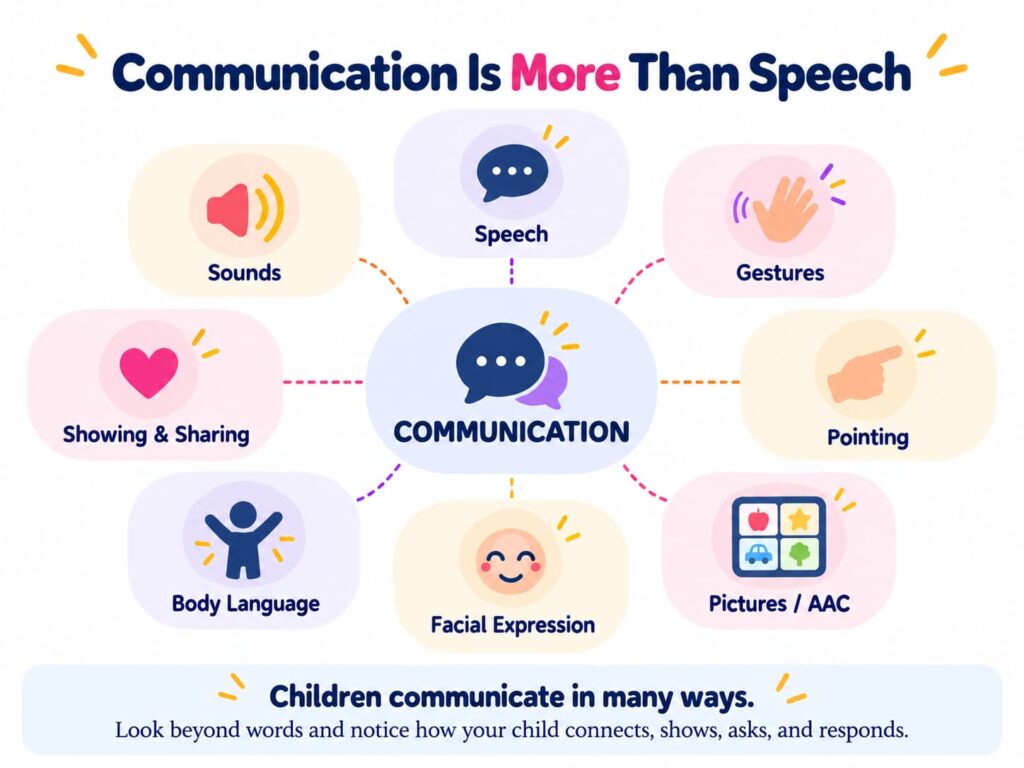
NIDCD explains that speech is only one way of expressing language and notes that children with delayed speech or language may need evaluation of both communication development and hearing.
This distinction matters because sometimes parents tell me:
“My child isn’t talking.”
But the next question should be:
“How is the child communicating without speech?”
That can tell us a lot more.
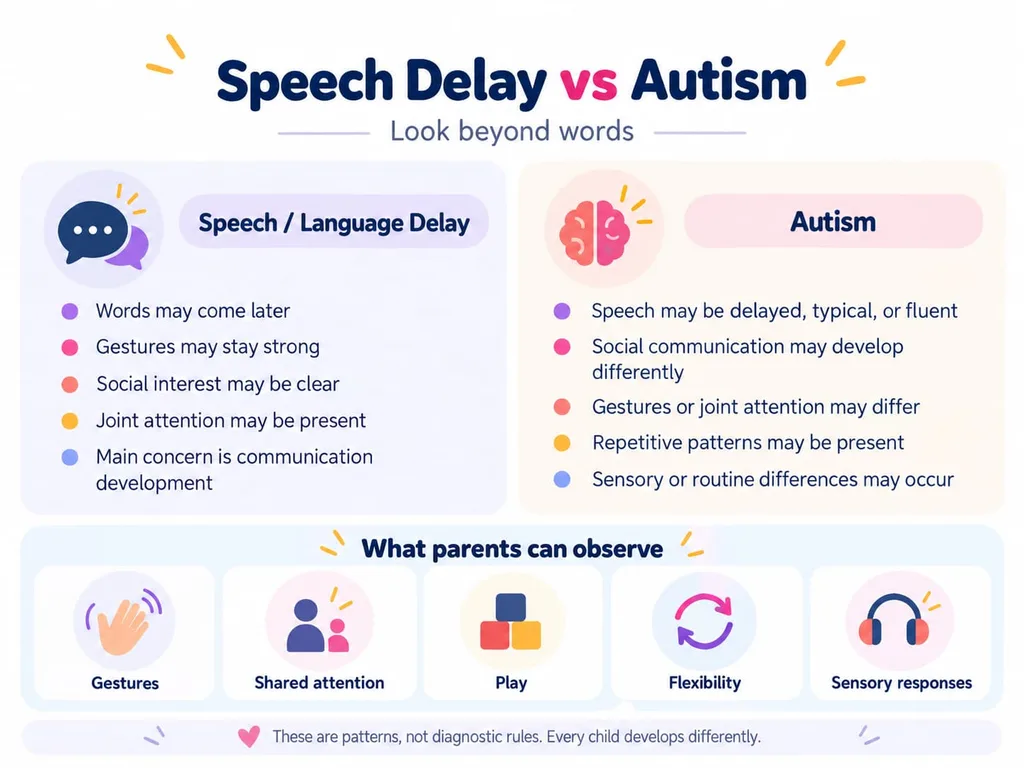
Speech Delay vs Autism: A Simple Comparison
This table is not a diagnostic test. It simply shows why professionals look beyond word count.
| Area | A child with an isolated speech/language delay may… | An autistic child may… |
|---|---|---|
| Spoken words | Develop spoken language later | Have delayed speech, typical speech, advanced vocabulary, or use little/no speech |
| Gestures | Frequently use pointing, reaching, waving or nodding to compensate for limited words | Use gestures differently, less frequently, or in less socially integrated ways |
| Joint attention | Often try to share interesting things even without words | May share attention or interests differently |
| Response to name | Often respond consistently when hearing is typical | May respond inconsistently |
| Social interaction | Often strongly seek interaction despite limited speech | May initiate or respond socially in different ways |
| Pretend play | May develop pretend play even with few words | Pretend play may be different, repetitive or less varied in some children |
| Repetitive behaviour | Not necessarily part of the language delay | Repetitive movements, interests, play or routines may be part of the broader profile |
| Sensory differences | Not necessarily related to the speech delay | Sensory seeking or sensory sensitivity may occur |
| Change and routines | May generally tolerate normal changes | Some children may strongly prefer predictability or routines |
There will be exceptions in both columns.
An autistic child may point.
An autistic child may make excellent eye contact.
An autistic child may love pretend play.
A child with language delay may also have sensory differences.
The purpose is not to put your child into a column.
It is to understand why professionals look at the whole developmental picture.
1. Look Beyond How Many Words Your Child Says
It is tempting to measure communication entirely by vocabulary.
We ask:
“How many words does she know?”
“Is he saying two-word combinations?”
“Can she say mummy?”
Those things matter.
But word count does not tell the complete story.
Consider two children who each use only five spoken words.
One child may point toward an aeroplane, look back toward their parent and smile as though saying:
“Did you see that?”
Another child may communicate differently and rarely involve another person when noticing something interesting.
Both children technically have five words.
But their social communication profiles may be quite different.
This is why ASHA recommends looking at gestures, play, nonverbal communication, social communication and functional use of communication when evaluating children with late language emergence.
2. Pay Attention to Gestures
Before children can explain everything with words, gestures do a lot of heavy lifting.
A young child might:
- point toward a biscuit,
- wave goodbye,
- nod yes,
- shake their head no,
- reach to be picked up,
- bring an object to a parent,
- or point toward something interesting.
A child with limited speech may still communicate very effectively using these methods.
Some autistic children also use gestures, but their gesture development or the way gestures combine with other communication may be different.
ASHA includes gestures, pointing, showing objects and sharing attention among important parts of early social communication development.
So instead of asking only:
“Is my child talking?”
you can also observe:
“What does my child do when they want to tell me something?”
3. Joint Attention Is an Important Piece of the Puzzle
This is one concept I think more parents should know.
Joint attention means sharing attention around the same object, event or experience with another person.
Imagine your child sees a dog outside.
They look at the dog.
Then look toward you.
Perhaps point.
Then look toward the dog again.
The message is almost:
“Look! Did you see that too?”
No sentence was spoken.
But a lot of communication happened.
Joint attention does not require perfect eye contact. A child may share attention through gaze shifts, gestures, body orientation, sounds or other communication. ASHA describes joint attention as an important aspect of social communication and also recognises that autistic people may express shared attention differently.
Some children with isolated language delay may have limited spoken language but continue sharing interests socially through gestures and attention.
Reduced or differently expressed joint attention can be part of an autistic developmental profile.
Again, it is one piece, not a diagnosis.
4. Observe How Your Child Responds to Other People
Another area worth observing is social response.
For example:
- Does your child usually notice when you call their name?
- Do they react when you change your facial expression?
- Do they participate in back-and-forth games?
- Do they bring you things?
- Do they try to get your attention?
- Do they imitate actions?
- Do they respond when you point toward something?
CDC includes response to name, gestures, shared interests and interactive play among social-communication behaviours considered when looking at possible autism.
But remember:
A child being deeply absorbed in a favourite activity and ignoring you once is normal childhood.
We are looking for patterns over time and across situations, not isolated moments.
5. Look at How Language Is Used, Not Just Whether It Exists
An autistic child may have plenty of words.
That sometimes surprises parents.
A child might:
- recite the alphabet,
- name dozens of animals,
- count very high,
- sing entire songs,
- remember advertisements,
- repeat dialogue from cartoons,
yet still find it difficult to use language flexibly for everyday communication.
For example, a child might know hundreds of words but struggle to say:
“Help me.”
“I don’t understand.”
“I need a break.”
“That hurts.”
“Can I play?”
NICE includes reduced functional use of language, repetitive phrases and unusual patterns of speech among features professionals may consider in an autism assessment.
That does not mean repetition is meaningless.
Sometimes repeated language is communication.
The important question is:
How is the child using their available communication?
6. What About Echolalia?
Echolalia means repeating words or phrases that someone else has said or that the child has heard elsewhere.
A child might repeat:
“Do you want juice?”
when they actually mean:
“I want juice.”
Or repeat a familiar line from a cartoon during a particular situation.
Echolalia can occur in autistic children, although repeated language by itself does not diagnose autism. NICE includes frequent repetition of set words or phrases among language features that can occur in autistic children.
Rather than immediately trying to stop repeated speech, it can be useful for parents and speech-language professionals to ask:
What might the child be communicating with that phrase?
7. Look at Play
Play tells us much more than whether a child knows how to use a toy “correctly.”
Watch how your child:
- explores objects,
- imitates you,
- plays pretend,
- changes ideas,
- responds when another person joins,
- takes turns,
- and uses toys in different ways.
A child with speech delay may have very limited spoken language while still creating imaginative play sequences.
An autistic child may also enjoy pretend play, but play may sometimes be more repetitive, highly focused or different from what parents expect.
NICE specifically warns professionals not to rule out autism because pretend play is present.
So once again:
There is no single “autistic way” to play.
8. Repetitive Behaviour and Strong Routines Matter Too
This is one of the biggest reasons speech delay and autism cannot be compared using language alone.
Autism may also involve patterns such as:
- repetitive movements,
- repeating the same play sequence,
- lining up objects,
- intense interests,
- strong preference for routine,
- difficulty with unexpected transitions,
- or unusual responses to sensory input.
The CDC includes repetitive play, routines, intense interests, repetitive movements and sensory responses among characteristics associated with autism.
A child with isolated speech delay would not necessarily show this broader pattern.
But a child can have both language delay and some repetitive behaviours without necessarily being autistic.
That is why evaluation matters.
9. Sensory Differences Can Be Another Clue
Some children seem overwhelmed by:
- loud appliances,
- hand dryers,
- crowded places,
- particular clothes,
- haircuts,
- food textures,
- bright environments,
- or touch.
Others actively seek sensory experiences through:
- jumping,
- spinning,
- rocking,
- crashing,
- climbing,
- chewing,
- touching,
- or constant movement.
These sensory patterns are common in autism but are not exclusive to autism.
With my son, I have learned that simply calling every unusual behaviour “bad behaviour” is not particularly useful. Sometimes I have to stop and ask what he might be seeking, avoiding, communicating or struggling with.
That shift from judging the behaviour to trying to understand the behaviour has been much more helpful for me as a parent.
10. Receptive Language Matters Too
Parents naturally notice expressive language first because it is visible.
We hear what our child says.
But understanding language matters just as much.
A child may struggle with:
- following simple instructions,
- understanding questions,
- identifying familiar objects,
- understanding everyday words,
- or processing spoken information.
ASHA distinguishes children who have primarily expressive language delay from those who have both expressive and receptive language delays.
This distinction is one reason a proper speech-language assessment can be more informative than simply counting words.
Could Hearing Problems Cause Speech Delay?
Yes, hearing should be considered whenever there are concerns about speech and language development.
A child does not need to be completely unable to hear for hearing differences to affect communication development.
NIDCD notes that hearing loss can contribute to delayed speech or language development and that hearing testing is often part of the evaluation process.
ASHA similarly recommends hearing screening or audiological assessment as part of evaluating late language development where appropriate.
That is why parents should avoid assuming:
“He doesn’t answer his name, so it must be autism.”
There may be several possible explanations worth investigating.
What About Children Growing Up With Telugu, Hindi and English?
This is especially relevant for Indian families.
Many of our children grow up hearing more than one language.
One parent may speak Telugu.
Grandparents may use another language.
School may use English.
Television may add Hindi.
Professionals should consider a child’s complete linguistic environment when assessing communication.
But parents should also not automatically dismiss persistent developmental concerns by saying:
“It’s only because we speak multiple languages.”
NICE specifically advises professionals not to assume language delay is explained simply because English is not the family’s first language. ASHA also emphasises cultural and linguistic context when evaluating communication.
A good assessment should consider how the child communicates across the languages they actually experience.
Can a Child Have Both Speech Delay and Autism?
Yes.
This is very important.
It is not:
Speech delay OR autism.
A child may be autistic and have significant speech or language difficulties.
Another autistic child may have fluent spoken language.
Another child may have speech delay without autism.
Another may have developmental language disorder.
Another may have hearing-related communication difficulties.
Another may have broader developmental delay.
That is why diagnosing from one symptom creates unnecessary confusion.
Speech Delay vs Autism: What Parents Can Observe at Home
Instead of trying to score your child, keep simple notes for a week or two.
Observe questions such as:
Communication
Does my child communicate needs somehow, even without speech?
Do they use gestures, sounds, pointing, pictures or actions?
Shared attention
Do they sometimes try to show or share interesting things with me?
Social response
How do they respond when other people try to interact?
Play
Do they explore toys in different ways?
Do they imitate actions?
Does pretend play appear?
Flexibility
How does the child respond when an activity or routine changes?
Sensory responses
Are there strong patterns involving sound, movement, touch, food or other sensory experiences?
Understanding
Does the child understand everyday instructions and familiar language?
Development over time
Are skills gradually appearing?
Or has the child stopped using skills they previously had?
This is not an autism checklist.
It is simply a better record to bring to a professional than:
“My child doesn’t talk much.”
One Thing I Would Take Seriously: Loss of Skills
If your child clearly loses language or social skills that were previously established, discuss that promptly with an appropriate healthcare professional.
NICE recommends autism assessment for children under three with regression in language or social skills and medical evaluation when older children show language regression or when motor skills are lost.
Regression can have different explanations.
Parents should not try to determine the cause themselves from internet searches.
What Helped Our Family
One thing I have learned through my own son’s journey is that speech cannot be looked at in isolation.
It is tempting to focus completely on:
“How many words is he saying?”
But communication affects everyday life in many ways.
Can the child tell us what they need?
Can they refuse something?
Can they ask for help?
Can they show us when something hurts?
Can they understand what is happening next?
Can they participate in a routine?
Those questions started feeling much more meaningful to me than simply comparing vocabulary with another child.
Visual routines have also helped us make some daily activities more predictable.
And working with professionals has taught me to describe what I actually observe instead of trying to diagnose it myself.
For example:
“He understands this instruction in one setting but struggles with it somewhere else.”
is much more useful than saying:
“He doesn’t understand anything.”
Specific observations give professionals something they can work with.
What Did Not Help Us
Comparing children did not help.
Waiting because somebody said:
“Boys always talk late.”
did not answer our developmental questions either.
And neither did the opposite extreme:
Watching one social-media video and deciding:
“My child does that. He must have autism.”
Both approaches oversimplify development.
What helped more was:
observe → document → discuss → understand → support
When Should Parents Seek Professional Guidance?
You do not have to determine whether the issue is “speech delay” or “autism” before asking for help.
That is the professional team’s job.
If you have persistent concerns about your child’s communication or broader development, you might start by discussing them with your paediatrician.
Depending on the concerns, assessment may involve:
- a paediatrician or developmental professional,
- a speech-language pathologist,
- an audiologist,
- and sometimes other developmental professionals.
NIDCD recommends discussing speech or language concerns with the child’s doctor and notes that assessment commonly involves a speech-language professional and hearing evaluation.
ASHA recommends that assessment of late language emergence consider not only spoken language but also hearing, gestures, social communication and play.
The American Academy of Pediatrics recommends developmental surveillance throughout childhood, general developmental screening at 9, 18 and 30 months, and autism-specific screening at 18 and 24 months.
For parents in India, the Rehabilitation Council of India maintains the Central Rehabilitation Register for recognised categories of rehabilitation professionals, including audiologists and speech professionals. Where relevant, parents can ask about professional qualifications and valid registration.
A Non-Diagnostic Parent Observation Checklist
This checklist is not designed to tell you whether your child has autism.
Use it only to organise your thoughts before speaking with a professional.
| What I am observing | Often | Sometimes | Rarely | Notes/example |
|---|---|---|---|---|
| Communicates needs using speech, gesture, pointing or another method | ☐ | ☐ | ☐ | |
| Responds to name in ordinary situations | ☐ | ☐ | ☐ | |
| Points or shows things to share interest | ☐ | ☐ | ☐ | |
| Uses gestures naturally | ☐ | ☐ | ☐ | |
| Participates in back-and-forth interaction | ☐ | ☐ | ☐ | |
| Imitates actions or sounds | ☐ | ☐ | ☐ | |
| Engages in varied play | ☐ | ☐ | ☐ | |
| Understands familiar everyday instructions | ☐ | ☐ | ☐ | |
| Handles small routine changes | ☐ | ☐ | ☐ | |
| Shows repetitive or highly focused patterns of play | ☐ | ☐ | ☐ | |
| Has strong sensory preferences or sensitivities | ☐ | ☐ | ☐ | |
| Has lost any skill previously used | ☐ | ☐ | ☐ |
Do not total the boxes.
Do not turn this into a score.
The value is in the examples you write in the last column.
Frequently Asked Questions
Does speech delay always mean autism?
No.
Children can have speech or language delays without being autistic. Autism involves a broader pattern involving social communication and interaction together with restricted or repetitive behaviours or interests.
Can an autistic child speak normally?
Yes.
Some autistic children have delayed speech. Others develop spoken language on a typical timeline or have extensive vocabularies.
NICE specifically cautions against ruling out autism simply because language milestones appear typical.
My child makes good eye contact. Does that mean it is only speech delay?
No.
Eye contact alone cannot distinguish speech delay from autism.
NICE advises professionals not to rule out autism simply because a child makes good eye contact, smiles or shows affection.
My child points and communicates but is not speaking much. Is that reassuring?
Gestures, pointing and attempts to share attention provide useful information about social communication.
But no single behaviour can rule autism in or out.
If speech or language development continues to concern you, discussing it with a qualified professional is still reasonable.
Is echolalia the same as speech delay?
No.
Echolalia refers to repeated words or phrases.
It can occur in autistic children and may sometimes serve a communicative function. It is different from simply developing spoken language later than expected.
Can a hearing problem look like speech delay or autism?
Some behaviours may overlap.
For example, a child with hearing difficulties may not consistently respond to speech and may develop spoken language later.
That is one reason hearing is often considered when evaluating communication delay.
Does speaking more than one language cause speech delay?
Children growing up in multilingual homes need to be evaluated within their full language environment.
Professionals should not dismiss persistent developmental concerns simply because the family uses more than one language.
Should I wait until age three before asking for an assessment?
You do not need to wait for a particular birthday if you already have persistent developmental concerns.
Developmental surveillance is recommended throughout childhood, and autism-specific screening is recommended by the AAP at 18 and 24 months.
Should I start speech therapy before knowing whether my child is autistic?
The appropriate support depends on the child’s individual communication needs and professional assessment.
You do not necessarily need to solve the diagnostic question before discussing identified communication difficulties with an appropriate professional.
A Father-to-Parent Thought
When a child is not talking as expected, words can become all we see.
Every day becomes:
“How many words today?”
“Did he say that properly?”
“Why isn’t he talking like that child?”
I understand why.
We desperately want communication.
But over time I have learned to appreciate communication in a wider sense.
A look.
A gesture.
A picture.
A request.
A refusal.
A child showing us something.
A child finding a way to say:
“Help me.”
Those things matter too.
Our job as parents is not to diagnose every difference.
It is to notice what our child can do, understand where they are struggling, and find appropriate support when needed.
Conclusion: Speech Delay vs Autism Is About More Than Words
When parents compare speech delay vs autism, the most useful question is usually not:
“How many words does my child say?”
It is:
“How does my child communicate and connect overall?”
Look at speech.
But also look at:
gestures,
shared attention,
play,
understanding,
social interaction,
repetitive patterns,
sensory responses,
flexibility,
and everyday participation.
One behaviour does not diagnose autism.
A speech delay does not automatically mean autism.
And fluent speech does not automatically rule autism out.
If your child’s development continues to concern you, write down what you observe and discuss those observations with an appropriate healthcare or developmental professional.
You do not need to know the diagnosis before asking the question.
Sometimes understanding begins simply by saying:
“I have noticed something, and I would like someone to help me understand it.”
For the bigger picture, read The Complete Autism Guide for Indian Parents.